
Updated July 2026 · ATO Compliant
Australian GST Calculator — Add or Remove GST Instantly
Calculate Australian Goods and Services Tax at the standard 10% rate. GST-free and input-taxed items are not subject to 10% GST.
Calculate Australian Goods and Services Tax at the standard 10% rate.
All calculations happen in your browser. We never collect or store your financial data.
The Three Formulas
How is GST Calculated in Australia?
Every GST calculation in Australia comes down to one of these three formulas. That’s it. No exceptions, no special cases — just pick the right one for what you need.
Add GST
Price × 1.1 = Total
Example: $1,000 × 1.1 = $1,100
GST: $100
REMOVE GST
Total ÷ 1.1 = Base Price
Example: $550 ÷ 1.1 = $500
GST was $50
FIND GST AMOUNT
Total ÷ 11 = GST
Example: $330 ÷ 11 = $30
Base price: $300
What is the GST calculation formula?
There are three. To add GST, multiply the base price by 1.1. To remove GST, divide the total by 1.1. To find just the GST amount in an inclusive price, divide by 11. These work because Australian GST is a flat 10% — always.
Want worked examples, Excel formulas, and the common mistake that costs people money? Read the full step-by-step guide →
The Basics
What is GST in Australia?
Goods and Services Tax — that’s what GST stands for. It’s a broad-based tax of 10% on most goods, services, and other items sold or consumed in Australia. Think of it as Australia’s version of the VAT (Value Added Tax) used in over 160 countries.
GST was introduced on 1 July 2000 and is administered by the Australian Taxation Office (ATO). The rate has been 10% since day one and has never changed.
Not everything attracts GST though. Basic food — fresh fruit, vegetables, meat, bread, milk, eggs — is GST-free. So are medical services, accredited education courses, and exported goods.
If you run a business with annual turnover of $75,000 or more, you’re required to register for GST. Non-profits get a higher threshold of $150,000. Taxi and rideshare drivers — Uber, Ola, DiDi — must register regardless of how much they earn.
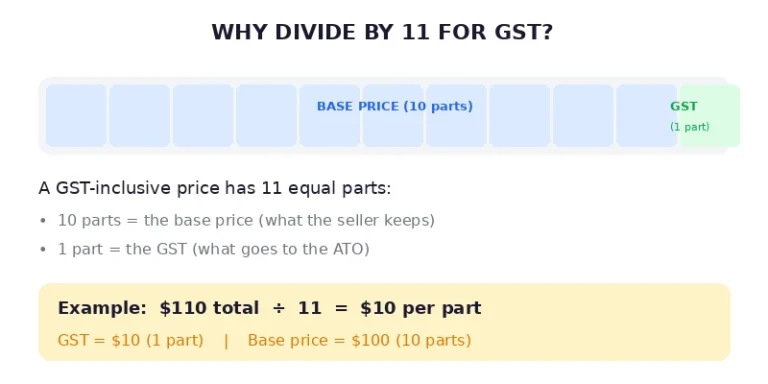
Why do you divide by 11 for GST?
Because Australian GST is 10% of the base price, not 10% of the total. A GST-inclusive price has 11 equal parts — 10 parts are the base price and 1 part is the GST. Dividing by 11 isolates that single GST part. So $110 ÷ 11 = $10 GST.
Common Mistake
The #1 GST Calculation Mistake
Here’s something that catches almost everyone the first time. You’ve got a GST-inclusive price of $220 and you want to find the base price. Your instinct says: just subtract 10%.
✗ Wrong
$220 − 10% = $198
✓ Correct
$220 ÷ 1.1 = $200
Why? Because GST is 10% of the base price, not 10% of the total. That’s a $2 difference on $220. On $110,000, it’s a $909 error. On a large property deal, you could be out by tens of thousands.
Why can’t I just subtract 10% to remove GST?
Because GST is 10% of the base price, not 10% of the total. The total already includes GST, so 10% of the total is a larger number than the actual GST. For example, 10% of $220 is $22, but the actual GST in $220 is only $20 ($220 ÷ 11). The correct method is to divide by 1.1.
Quick Reference
GST on Common Amounts
Here’s what 10% GST looks like on everyday amounts. Whether you’re quoting a job, checking an invoice, or doing a back-of-the-envelope calculation, this table saves you reaching for the calculator.
|
Amount (ex GST) |
GST (10%) |
Total (inc GST) |
|---|---|---|
|
$50 |
$5.00 |
$55.00 |
|
$100 |
$10.00 |
$110.00 |
|
$200 |
$20.00 |
$220.00 |
|
$500 |
$50.00 |
$550.00 |
|
$1,000 |
$100.00 |
$1,100.00 |
|
$2,000 |
$200.00 |
$2,200.00 |
|
$5,000 |
$500.00 |
$5,500.00 |
|
$10,000 |
$1,000.00 |
$11,000.00 |
|
$20,000 |
$2,000.00 |
$22,000.00 |
|
$50,000 |
$5,000.00 |
$55,000.00 |
|
$100,000 |
$10,000.00 |
$110,000.00 |
Reverse Lookup
GST Already Included? Find the Base Price
Got a receipt or invoice showing the total? You need the base price for your BAS or bookkeeping. Here’s how much GST is baked into common amounts.
|
Amount (inc GST) |
GST Component |
Base Price (ex GST) |
|---|---|---|
|
$55 |
$5.00 |
$50.00 |
|
$110 |
$10.00 |
$100.00 |
|
$220 |
$20.00 |
$200.00 |
|
$550 |
$50.00 |
$500.00 |
|
$1,100 |
$100.00 |
$1,000.00 |
|
$2,200 |
$200.00 |
$2,000.00 |
|
$5,500 |
$500.00 |
$5,000.00 |
|
$11,000 |
$1,000.00 |
$10,000.00 |
|
$22,000 |
$2,000.00 |
$20,000.00 |
|
$55,000 |
$5,000.00 |
$50,000.00 |
|
$110,000 |
$10,000.00 |
$100,000.00 |
What is the difference between GST-inclusive and GST-exclusive?
A GST-inclusive price already has the 10% GST built in — it’s the final amount the customer pays. A GST-exclusive (“ex GST”) price is the base amount before GST. Under Australian Consumer Law enforced by the ACCC, prices displayed to consumers must include GST. Business-to-business pricing often shows the ex-GST figure.
Common GST Amounts
How Much GST on…? Quick Answers
These are the most-searched GST questions in Australia. If you’re wondering how much GST applies to a specific amount, here’s your answer — both ways.
How much GST on $100?
Adding GST: $10, total $110. If $100 includes GST: GST is $9.09, base $90.91.
How much GST on $500?
$500 + GST = $550 (GST: $50). If $500 includes GST: $45.45 GST, base $454.55.
How much is $1,000 plus GST?
$1,000 × 1.1 = $1,100 (GST: $100). If $1,000 includes GST: $90.91 GST, base $909.09.
How much is $2,000 plus GST?
$2,000 + GST = $2,200. The GST component is $200.
How much GST on $3,000?
$3,000 + GST = $3,300 (GST: $300). If $3,000 includes GST: $272.73 GST.
How much is $5,000 plus GST?
$5,000 + GST = $5,500. The GST is $500.
What is the GST on $20,000?
$20,000 + GST = $22,000 (GST: $2,000). If includes GST: $1,818.18 GST.
What is the GST on $60,000?
$60,000 + GST = $66,000. GST: $6,000. If includes GST: $5,454.55 GST.
How much GST on $100,000?
$100,000 + GST = $110,000 (GST: $10,000). If includes GST: $9,090.91 GST.
What is the GST on $500,000?
$500,000 + GST = $550,000 (GST: $50,000). For property, see our margin scheme calculator.
Your Questions, Answered
GST Questions Australian Business Owners Actually Ask
Does GST come out of my pocket as a business owner?
No. GST is a pass-through. Instead of charging $100, you charge $110. The customer pays the extra $10, and you remit that $10 to the ATO. You also claim back any GST you pay on business purchases. The net effect? GST costs your business nothing. The consumer bears it.
If I register for GST, do I have to raise my prices?
Most businesses do — you simply add 10% to your pricing. But some choose to absorb the GST to stay competitive. Fair warning: absorbing it means every $100 you earn is really only $90.91 to you, since $9.09 goes to the ATO as GST. Run the numbers before deciding.
I just hit $75,000 turnover — do I owe GST on everything I’ve already earned?
No. GST applies from your registration date forward, not retroactively. You have 21 days from when you reach the $75,000 threshold to register. But if you should have registered earlier and didn’t, the ATO can require you to pay 1/11th of all sales since the date you were required to register, plus interest.
Is my data safe when using this calculator?
Yes. All calculations happen entirely in your browser using JavaScript. Nothing is sent to any server. We don’t collect, store, or transmit any numbers you enter. No login, no cookies tracking your calculations.
Do Uber and rideshare drivers need to register for GST?
Yes — always, regardless of turnover. If you provide taxi or rideshare services (Uber, Ola, DiDi), you must register for GST from your first dollar. This is different from other businesses, which only need to register at $75,000.
Frequently Asked Questions
GST Calculator FAQs
Buying a car? Our guide to GST on cars in Australia covers new, used and private sales with worked examples at common price points.
Buying or selling property? GST depends on whether it’s existing, new or commercial. Our guide to GST on property in Australia covers all three with worked examples.