
GST-Free Guide
Complete List of GST-Free Items in Australia (2026)
Not everything you buy in Australia carries the 10% GST. Basic food, most healthcare, accredited education, childcare and exports are all GST-free under the A New Tax System (Goods and Services Tax) Act 1999.
For items bought from a shop and not eaten on the premises. Restaurant meals and hot takeaway food are taxable. Source: the ATO detailed food list.
And if you run a business selling GST-free items, there’s a bonus most people miss: you don’t charge GST to your customers, but you can still claim input tax credits on your related business purchases.
The input tax credit part matters. It’s what separates “GST-free” from “input-taxed” — two labels that sound the same but work very differently for your bottom line. We’ll get to that.
This page is the full GST exemption list. Every major GST-free category, the odd exceptions inside each one, and the borderline cases people actually argue about — sourced from the ATO and the GST Act itself. If you just want to run the numbers, our GST calculator does the maths for you.
What does “GST-free” mean?
A GST-free supply is a sale where no GST is charged, but the business can still claim input tax credits on related purchases. It’s different from “input-taxed,” where you can’t claim those credits. People also call these GST-exempt or non-GST items, and the law calls them GST-free supplies.
Quick Answers
Most-Searched Items: GST or GST-Free?
These are the items people ask about most. “Depends” means the basic product is GST-free but some versions are taxed, so read the note.
|
Item |
GST? |
The rule |
|---|---|---|
|
Milk |
GST‑free |
Plain milk, including UHT and powdered milk, is GST-free. Flavoured milk drinks are taxed. |
|
Bottled water |
GST‑free |
Plain, still bottled water with nothing added is GST-free. Flavoured water and soda water are taxed. |
|
Eggs |
GST‑free |
Fresh, frozen and dried eggs are all GST-free. |
|
Bread |
Depends |
Plain bread and rolls are GST-free. Bread with icing or a sweet filling is taxed. |
|
Coffee |
Depends |
Beans, ground, instant coffee and capsules are GST-free. A café coffee or ready-to-drink iced coffee is taxed. |
|
Tea |
Depends |
Tea bags and loose-leaf tea are GST-free. Ready-to-drink iced tea is taxed. |
|
Sparkling water |
Depends |
Naturally carbonated mineral water is GST-free. Soda water and flavoured sparkling water are taxed. |
Not on the list? Use the GST-free item checker at the top of this page, or see GST on food for takeaway, café and hot food rules.
Food & Groceries
GST-Free Food in Australia
Here’s the general rule: most food is GST-free. It becomes taxable when it’s eaten on the premises, sold hot to take away, or falls into a taxable category such as snacks, confectionery or prepared meals.
Sounds simple. It isn’t always. The GST Act’s Schedule 1 lists taxable foods in surprising detail, and the borderline cases keep tax lawyers busy. But for everyday shopping, these lists cover almost everything.
Food That IS GST-Free
- Fresh, frozen and raw meat for human consumption (not prepared meals)
- Bread and bread rolls without a sweet filling or sweet coating — a glaze doesn’t count as a sweet coating
- Eggs
- Plain, still bottled water (no bubbles, no additives)
- Baby food, and infant formula marketed for babies up to 12 months (per GSTD 2026/1)
- Dried pasta, rice, cereals
- Frozen and canned vegetables
- Fresh fruit and vegetables
- Milk — plain and UHT — plus cream and cheese
- Flour, sugar, cooking ingredients, and baking mixes without taxable ingredients
- Tea and coffee — beans, ground, instant
- Cooking oils, spreads, butter, margarine
- Herbs, spices, condiments
Food That Is NOT GST-Free
- Prepared meals and restaurant food
- Confectionery — chocolate, lollies, chewing gum
- Soft drinks, energy drinks, flavoured milk, soda water, and sparkling or flavoured water with added carbonation or flavouring
- Packaged ice, ice cream, chips and savoury snacks
- Biscuits, crackers and crispbreads
- Hot takeaway food — think hot chips, kebabs or a rotisserie chicken
- Any food consumed on the premises — restaurant, café, food court
- Alcohol (beer and spirits also carry excise; wine carries wine equalisation tax)
The Bread Roll Rule
Same bread roll, two different tax treatments. Buy a plain roll from the supermarket or bakery and it’s GST-free. Order that identical roll with your meal at a restaurant and it’s taxable. Context decides — not the product.
This is the single best example of how Australian GST works on food. Where and how you buy something can matter more than what it is.
For a detailed breakdown of what’s taxed and what’s not — including grey areas like sushi, smoothies, and rotisserie chicken — see our full guide to GST on food in Australia.
Is bread GST-free in Australia?
Plain bread and bread rolls are GST-free when purchased from a shop. Bread with sweet filling or coating is taxable. Bread consumed in a restaurant is also taxable. A glaze is not considered a sweet coating.
Is food GST-free in Australia?
Most basic, unprocessed food is GST-free — fresh fruit, vegetables, meat, bread, milk, eggs, and cooking ingredients. Prepared meals, restaurant food, confectionery, snack foods, and soft drinks are NOT GST-free.
Health & Medical
GST-Free Health and Medical Services
Healthcare is the second big GST-free category, and the rule of thumb is straightforward: if a recognised health professional provides a listed health service that’s necessary for appropriate treatment, there’s no GST on it.
That covers:
- Medical services from doctors, plus listed health services such as dental, optometry, physiotherapy and chiropractic
- PBS-listed medicines, and prescription-only medicines supplied on a prescription
- Certain medical aids and appliances listed in Schedule 3 of the GST Act
- Hospital treatment
- Other listed health services, such as psychology, dietary advice, occupational therapy and podiatry
But “health-adjacent” doesn’t mean GST-free. These all attract the full 10%:
- Cosmetic procedures
- Gym memberships and wellness retreats
- Most over-the-counter medicines
- Personal protective equipment — masks, gloves
So your physio appointment is GST-free, but the resistance bands they sell you at reception aren’t. The service is exempt; the retail product isn’t.
Are medical services GST-free?
Yes — medical services from doctors are GST-free, and so are listed health services from recognised professionals, such as dentists, optometrists and physiotherapists, when the treatment is necessary. Cosmetic procedures that aren’t medically necessary attract GST.
Education
GST-Free Education Courses
Accredited education is GST-free from pre-school right through to university:
- Accredited primary, secondary and tertiary courses
- Course materials supplied by the education provider as part of the course
- Pre-school and kindergarten
- Professional or trade courses that lead to a qualification you need to work in that profession or trade
The word doing the heavy lifting there is accredited. A non-accredited short course, a weekend hobby class, or corporate training without accreditation all attract GST. So do school uniforms and textbooks you buy separately from the school — the exemption covers the course, not everything orbiting it.
Childcare
GST-Free Childcare
Short section, simple rule: there’s no GST on childcare fees for approved childcare services — long day care, family day care, and outside school hours care all qualify. If the provider is approved under Australia’s childcare framework, no GST applies to the fees.
Exports
GST-Free Exports
Goods exported from Australia are GST-free, provided the supplier exports them within 60 days of receiving any payment or issuing an invoice, whichever happens first.
One catch for businesses: the supplier generally needs to be the exporter. Sell goods to someone locally who says they’ll export them, and you may still need to charge GST unless specific conditions in the GST law are met. Keep the export documentation. The ATO will want to see it.
Other Categories
Other GST-Free Goods and Services
A handful of categories round out the list:
- Water supply, sewerage and drainage services
- Certain supplies for people with disabilities — including cars and car parts for eligible people, when a completed declaration is given to the supplier
- Some charitable activities
- Residential care (aged care)
- Religious services
- International transport of passengers and goods to and from Australia, including international airfares
A few items people often assume are GST-free work a little differently. Precious metals such as investment gold, silver and platinum are GST-free only on the first sale after refining; later sales are input-taxed. Gift vouchers have no GST when you sell them, because the GST applies to whatever the voucher is spent on. And a genuine donation isn’t payment for anything, so there’s no GST on it at all.
None of these are huge search categories, but they matter if you’re in the sector. The disability car exemption in particular trips people up — it’s not automatic: you must meet the eligibility rules and give your supplier a completed declaration.
Wondering about overseas digital subscriptions like Netflix or software? Those aren’t GST-free. Our guide to GST on overseas subscriptions explains when the 10% GST applies and when it doesn’t.
The Distinction That Matters
GST-Free vs Input-Taxed — What’s the Difference?
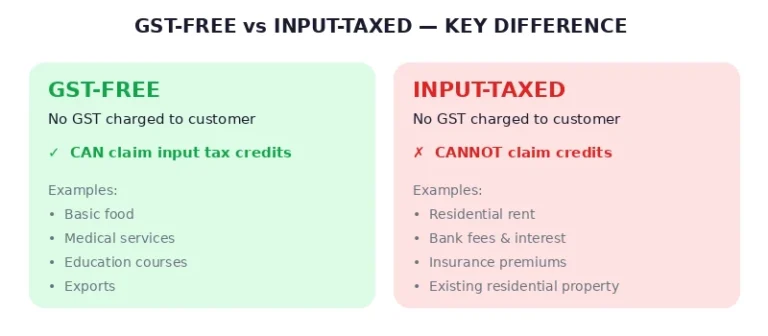
Two categories, both with no GST on the price tag. From the customer’s side they look identical. From the business side they’re worlds apart. They also need different GST codes in your accounting software.
|
Feature |
GST-Free |
Input-Taxed |
|---|---|---|
|
GST charged to customer |
No |
No |
|
Claim input tax credits? |
Yes ✓ |
No ✗ |
|
Examples |
Food, health, education |
Residential rent, financial services |
|
Impact on business |
Neutral — you still get credits |
Negative — you absorb GST on expenses |
Sell GST-free goods — say you run a fruit shop — and you can still claim back the GST built into your rent, refrigeration, delivery van and shelving. The exemption costs you nothing.
But rent out a residential property? That’s input-taxed. No GST on the rent, and no credits on your expenses either. The GST inside your agent fees, repairs and maintenance just becomes part of your cost base. Same “no GST” label on the invoice. Very different economics underneath.
What is the difference between GST-free and input-taxed?
Both have no GST charged, but with GST-free supplies you can still claim input tax credits on your business purchases. With input-taxed supplies (residential rent, bank fees, financial services), you cannot claim those credits — you absorb the GST cost.
Common Questions
GST-Free Items — Frequently Asked Questions
Written and reviewed by the GST Calculator Australia team against current ATO guidance. Last reviewed 17 November 2026. General information only, not tax advice. See our editorial policy.