
Australian Tax Essentials
What is GST in Australia? Rate, Rules & Who Pays
Goods and Services Tax (GST) is a broad-based tax of 10% on most goods, services, and other items sold or consumed in Australia. It was introduced on 1 July 2000 under the Howard government as part of a major overhaul of Australia’s tax system, replacing a patchwork of federal and state taxes.
GST is administered by the Australian Taxation Office (ATO) and is collected at every stage of the supply chain — from manufacturer to wholesaler to retailer. Consumers pay the final GST amount, and businesses along the chain claim back the GST they’ve already paid through input tax credits.
So how much is GST in Australia? It’s 10%, a single rate that hasn’t changed since GST began. The details are below.
What Is the GST Rate in Australia?
The GST rate in Australia is 10%, and it hasn’t changed since GST started on 1 July 2000. It’s a federal tax, so the rate is the same in every state and territory: GST in Victoria, Queensland, NSW or anywhere else is 10%. Because GST is added on top of the price, it makes up one-eleventh of a GST-inclusive price, which is why you divide by 11 to find the GST.
Unlike India (main rates of 5% and 18%, plus 40% on select goods) or the UK (standard, reduced and zero rates), Australia has one rate for everything that’s taxable.
How It Works
How Does GST Work? The Supply Chain
GST is a multi-stage tax, but it doesn’t snowball. Each business in the chain only pays GST on the value it adds — not on the full price.
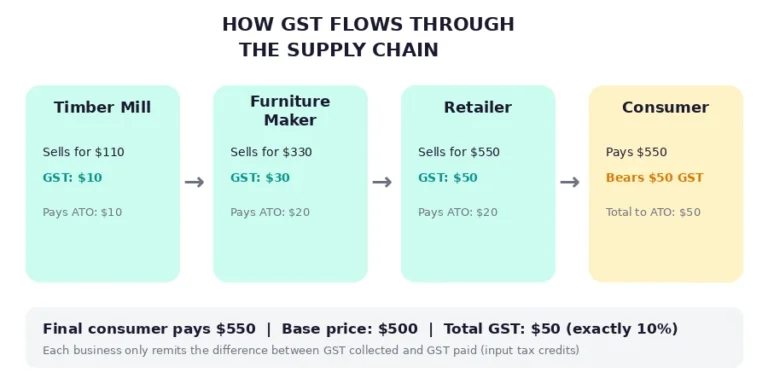
Here’s a simplified example of a product moving from manufacturer to consumer:
|
Stage |
Sale Price (ex GST) |
GST Charged |
GST Credits |
Net GST to ATO |
|---|---|---|---|---|
|
Manufacturer → Wholesaler |
$100 |
$10 |
$0 |
$10 |
|
Wholesaler → Retailer |
$150 |
$15 |
$10 |
$5 |
|
Retailer → Consumer |
$200 |
$20 |
$15 |
$5 |
|
Total GST collected by ATO |
$20 |
The consumer pays $220 ($200 + $20 GST). The ATO receives $20 in total — collected in three instalments from three businesses. No business bears the cost; they pass it through.
Does GST come out of a business owner’s pocket?
No. GST is a pass-through tax. You collect it from your customers and remit it to the ATO. You also claim back GST you pay on business purchases. The consumer bears the final cost.
Supply Types
Taxable, GST-Free, and Input-Taxed — The Three Types of Supply
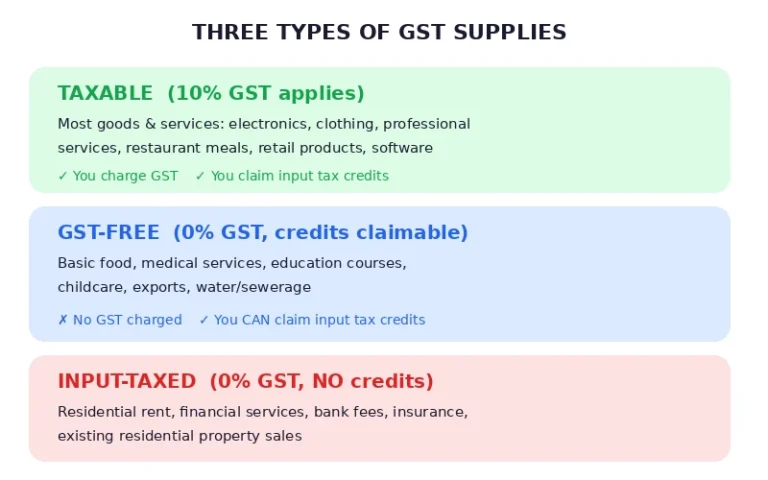
Not everything in Australia attracts GST. The GST Act classifies all sales into three categories:
Taxable supplies
GST of 10% applies. Most goods and services fall here. Examples: electronics, clothing, professional services, restaurant meals, software subscriptions.
GST-free supplies
No GST is charged, but the business can still claim input tax credits on related purchases. Examples: most basic foods, medical services, education courses, exports, childcare.
Input-taxed supplies
No GST is charged, and the business cannot claim input tax credits. Examples: residential rent, financial services (bank fees, interest, life insurance premiums), sale of existing residential property.
The critical difference between GST-free and input-taxed is credits. A business making GST-free supplies gets its input credits back. A business making input-taxed supplies absorbs the GST on its costs.
For a full guide on what you can claim and how to report it on your BAS, see our guide to input tax credits.
Registration
Who Must Register for GST?
Registration is mandatory if your business meets any of these conditions:
Annual turnover of $75,000 or more — this is gross income, not profit. Once you reach this threshold (or reasonably expect to), you have 21 days to register.
Non-profit organisations with $150,000+ turnover — a higher threshold recognising their community role.
Taxi and rideshare drivers — Uber, Ola, DiDi, and any similar platform. Must register from dollar one, regardless of turnover.
Registration requires an Australian Business Number (ABN). You can register online through the ATO’s Business Registration Service.
Voluntary registration is also an option. If your turnover is below $75,000 but you have significant GST-inclusive business expenses (equipment, vehicles, supplies), registering lets you claim those credits back. The trade-off: you must charge GST on your sales and lodge BAS returns.
For a full breakdown of when to use inclusive vs exclusive pricing and what Australian law requires, see our guide to GST-inclusive vs GST-exclusive pricing.
Do I have to register for GST under $75,000?
No. Registration is optional below $75,000. But voluntary registration lets you claim GST credits on business purchases. You generally must stay registered for at least 12 months.
History
When Was GST Introduced in Australia?
GST commenced on 1 July 2000 as part of “A New Tax System” introduced by the Howard government. It replaced the Wholesale Sales Tax (WST) and a range of state taxes.
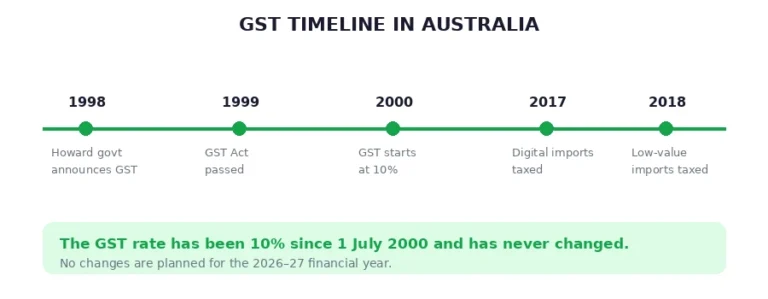
1998 — Treasurer Peter Costello announces the GST proposal alongside income tax cuts and the abolition of WST.
1999 — The A New Tax System (Goods and Services Tax) Act 1999 passes parliament after negotiations with the Australian Democrats. Fresh food is excluded from GST as part of the deal.
1 July 2000 — GST takes effect. The rate is set at 10%.
2000–2026 — The rate has never changed. Multiple governments have considered increasing it, but no change has been legislated.
2017 and 2018: GST extended to overseas digital services and digital products from 1 July 2017 (often called the “Netflix tax”), then to low-value imported goods of $1,000 or less from 1 July 2018.
Exemptions
What Items Are GST-Free?
Basic food
Fresh fruit, vegetables, meat, bread, milk, eggs, cooking ingredients. But not prepared meals, restaurant food, takeaway, confectionery, snack foods, or soft drinks.
Health and medical
Medical services, listed health services from recognised professionals, PBS-listed and prescription-only medicines, hospital treatment.
Education
Accredited primary, secondary, and tertiary courses, including course materials supplied by the provider.
Childcare
Approved long day care, family day care, and outside school hours care.
Exports
Goods the supplier exports within 60 days of receiving any payment or issuing an invoice, whichever happens first.
Water and sewerage
Water supply, sewerage and drainage services.
For the complete breakdown with edge cases and examples, see our full GST-free items list.
International Comparison
Is GST the Same as VAT?
Essentially, yes. GST and VAT (Value Added Tax) are the same type of tax — a consumption tax collected at each stage of the supply chain. The mechanism is identical. Only the name and the rate differ.
|
Country |
Tax Name |
Rate |
|---|---|---|
|
Australia |
GST |
10% |
|
New Zealand |
GST |
15% |
|
Singapore |
GST |
9% |
|
United Kingdom |
VAT |
20% |
|
Canada |
GST (federal) |
5% |
|
India |
GST |
5% and 18% (plus 40% on select goods) |
|
EU average |
VAT |
~21% |
Australia’s 10% sits well below the global average for consumption taxes. The simplicity of a single rate (compared to India’s multiple rates or the EU’s multiple rates) makes compliance relatively straightforward.
Thresholds
The $75,000 GST Threshold — What Counts as Turnover?
“Turnover” for GST purposes means your gross business income — not profit. Revenue before expenses. This catches many new business owners off guard.
For example, if your business earns $80,000 in revenue but has $60,000 in expenses, your profit is $20,000 — but your GST turnover is $80,000. You must register.
The ATO uses two tests:
Current turnover — your actual turnover for the past 12 months. If it’s hit $75,000, register within 21 days.
Projected turnover — your likely turnover for the next 12 months. If you reasonably expect to reach $75,000, register now. The ATO gives the example of “Barry,” a sole trader who monitors his monthly income and projects forward.
GST turnover includes all sales connected with your business — cash, credit, barter, and in-kind. It excludes GST, input-taxed sales, sales not connected with your business and sales not connected with Australia.
Crossed the threshold recently? GST applies from the date you’re registered, but the ATO can backdate your registration if you were late. Our guide to registering for GST explains the 21-day rule and what happens to sales made before you registered.
Frequently Asked Questions
GST in Australia FAQs
Written and reviewed by the GST Calculator Australia team against current ATO guidance. Last reviewed 17 November 2026. General information only, not tax advice. See our editorial policy.