
FREE TOOL — DIVISIONS 75 & 66
Margin Scheme GST Calculator Australia — For Property & Second-Hand Goods
Calculate GST for eligible property sales under Division 75 or estimate GST on eligible second-hand goods under Division 66. Choose a mode, enter the purchase and sale prices, and view the GST breakdown.
Division 75 property estimate. Written agreement and eligibility rules apply.
Sale price is below purchase price — the margin is negative, so no GST is payable under the margin scheme.
All calculations happen in your browser. No data is collected.
The Concept
What is the GST Margin Scheme?
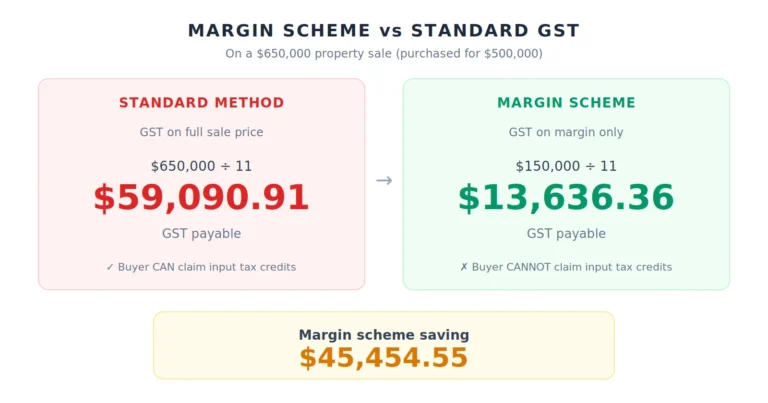
Normally, GST on a sale is 1/11 of the full sale price. Sell a property for $650,000 the standard way and the GST is $59,090.91. That’s a serious number.
The margin scheme — Division 75 of the GST Act — changes what gets taxed. Instead of the whole sale price, GST applies only to your margin: the sale price minus what you originally paid. Under the margin scheme, GST is calculated as 1/11 of the margin — the sale price minus the purchase price — not 1/11 of the full sale price. You’re taxed on the value you added, not the value that was already there.
It exists mostly for property. When land or premises were bought without GST being claimable — from a private seller, or before GST existed, or under the margin scheme itself — taxing the entire resale price would tax value that already passed through the system untaxed. The margin scheme fixes that. It also applies in some second-hand goods situations, though property is where the real money moves.
One trade-off to know upfront: when you sell under the margin scheme, your buyer can’t claim an input tax credit on the purchase. That’s fine when the buyer is a home buyer or investor who couldn’t claim anyway. It matters when the buyer is a GST-registered business.
For a detailed guide on property eligibility, developer vs investor rules, and the mistakes that cost thousands, see our guide to margin scheme GST for property.
The Maths
The Margin Scheme Formula
Margin Scheme GST
GST = (Sale Price − Purchase Price) ÷ 11
Worked example, real numbers:
- Bought property: $500,000
- Sold property: $650,000
- Margin: $650,000 − $500,000 = $150,000
- GST under the margin scheme: $150,000 ÷ 11 = $13,636.36
Compare that to the standard method:
- Standard GST: $650,000 ÷ 11 = $59,090.91
- Saving: $45,454.55
A property bought for $500,000 and sold for $650,000 pays $13,636.36 GST under the margin scheme, compared to $59,090.91 under the standard method. Same property, same sale price, $45,000 difference. This is why developers and their accountants care so much about margin scheme eligibility — on a multi-lot subdivision, the saving repeats on every single lot.
Why divide by 11 and not multiply by 10%?
Because the margin is treated as GST-inclusive. The GST inside any GST-inclusive amount is 1/11 of it — the same rule as everywhere else in Australian GST. Multiplying the margin by 10% overstates the GST.
Who Can Use It
When Can You Use the Margin Scheme?
Broadly, you can apply the margin scheme when you’re selling property as part of a business and the property came to you without a full input tax credit attached. Not sure whether the margin scheme applies to your property sale? Our guide to GST on property explains when each method applies and includes a side-by-side worked example. That includes property that was:
- Bought from a seller who wasn’t registered for GST (a private vendor, for example)
- Bought before 1 July 2000, when GST commenced
- Bought under the margin scheme itself
- Acquired as an input-taxed supply
And here’s the hard exclusion: if you bought the property as a fully taxable supply under the standard method — GST charged on the full price, credit claimable — you cannot use the margin scheme when you sell. The chain matters. How the property entered your hands determines how it can leave.
The seller and buyer must agree in writing to apply the margin scheme, usually in the contract of sale. The agreement generally needs to be in place on or before settlement. No written agreement, no margin scheme — the ATO doesn’t accept a handshake on this one.
For second-hand goods, dealers who buy stock from unregistered sellers (think used cars from private owners) have their own version of margin-based rules, but the mechanics differ enough that property and goods shouldn’t be lumped together. If you’re a dealer, get specific advice.
Watch Out
Common Margin Scheme Mistakes
Using the wrong purchase price. The margin is calculated from your actual acquisition cost — or, for property held since before GST, from an approved valuation as at 1 July 2000. Guessing, or using a later valuation because it’s higher, is the fastest way to an ATO adjustment. Stamp duty and buying costs don’t get added to the purchase price either, which surprises people.
Forgetting the written agreement. The margin scheme isn’t something you decide at BAS time. If the contract doesn’t contain the agreement and settlement has passed, you’re generally stuck with the standard method — a $45,000 mistake in our example above.
Not keeping the records. You need to prove what you paid, when, and how the property was acquired — sometimes decades later. Contracts, settlement statements, valuations. Keep them for as long as you hold the property, plus five years after the sale.
Common Questions