Margin Scheme GST for Property — How Developers and Investors Save Thousands
The GST margin scheme lets you pay GST on the profit margin of a property sale instead of the full sale price. On a property bought for $600,000 and sold for $1.1 million, the standard method charges GST on the entire $1.1 million — that’s $100,000. The margin scheme charges GST only on the $500,000 difference — that’s $45,454. Same property, same sale, $54,546 less GST.
Not every property sale qualifies. The eligibility rules are strict, the written agreement must happen before settlement, and getting it wrong means the ATO treats the sale as fully taxable. But when it works, the margin scheme is one of the biggest GST savings available to Australian property developers and investors.
Our margin scheme calculator does the maths for you instantly. This post covers when the margin scheme applies to property, who’s eligible, and the mistakes that cost developers tens of thousands of dollars.
HOW IT WORKS IN ONE LINE
Margin scheme GST = (sale price minus purchase price) divided by 11. You pay GST on the margin, not the full price. Written agreement required before settlement.
Standard Method vs Margin Scheme — The Dollar Difference
Under the standard method, GST on a property sale is one-eleventh of the full sale price. That’s the same divide-by-11 rule that applies to any GST-inclusive transaction. Sell a property for $1.1 million, and $100,000 goes to the ATO as GST.
Under the margin scheme, GST is one-eleventh of the margin — the gap between what you paid for the property and what you sold it for. Buy for $600,000, sell for $1.1 million, and your margin is $500,000. One-eleventh of that margin is $45,454. That’s the GST.
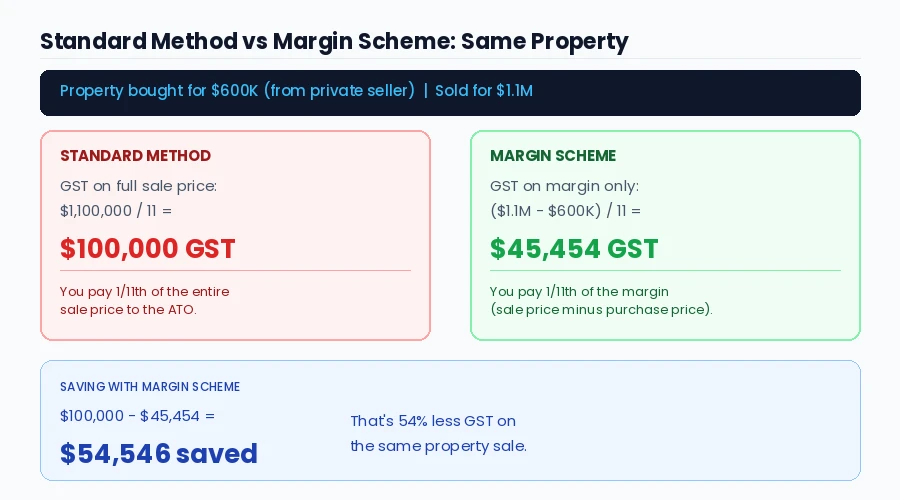
The saving scales with the purchase price. A property bought cheaply and sold for a large profit has a big margin — so the GST saving is smaller relative to the sale price. A property where the margin is thin (bought at $900K, sold at $1.1M) saves the most — GST drops from $100,000 to just $18,181.
Who Can Use the Margin Scheme
The margin scheme isn’t available on every property sale. The ATO sets out specific eligibility paths, and your property must fit at least one of them. The test is about how you acquired the property — not about what you do with it.
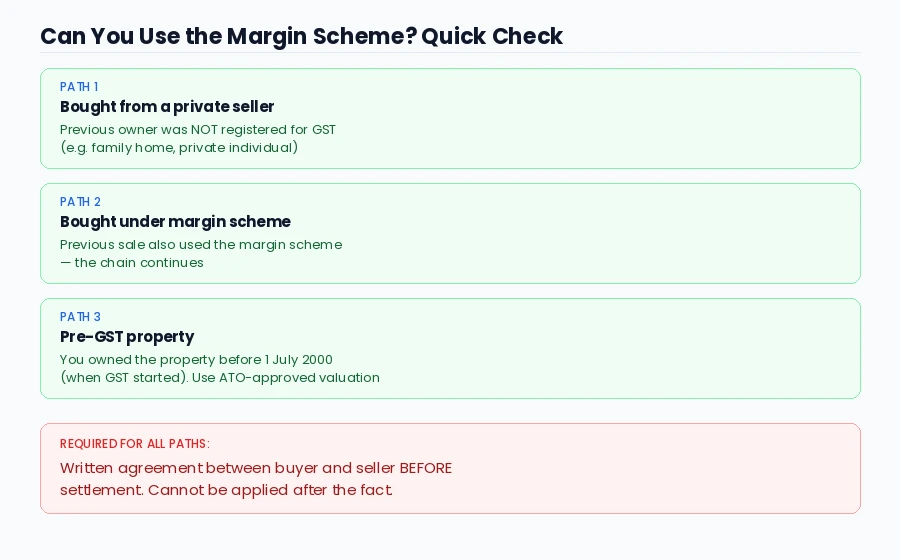
ELIGIBLE
Bought from a private individual not registered for GST
Bought from a seller who also used the margin scheme
Owned the property before 1 July 2000 (pre-GST)
Bought as a GST-free going concern
NOT ELIGIBLE
Bought from a GST-registered seller who charged full GST (not margin scheme)
Claimed full GST credits on the purchase
No written agreement in place before settlement
The most common path for developers is buying land from a private owner — a family selling their home, a farmer selling a paddock, a deceased estate. These sellers are almost never GST-registered, which makes the purchase eligible for the margin scheme when you later sell the developed property.
The Written Agreement Rule
This is where deals fall apart. The ATO requires a written agreement between buyer and seller to use the margin scheme, and that agreement must be in place on or before the settlement date. Not after. Not at the next BAS. Not when the accountant suggests it six months later.
Most property contracts in Australia include a tick box or special condition for the margin scheme. If neither party ticks it — or if the clause isn’t in the contract at all — the margin scheme can’t be applied to that sale. The ATO has been clear on this: the election can’t happen after the fact.
REAL COST OF MISSING THE AGREEMENT
A developer sells a townhouse for $880,000 with a $400,000 margin. Margin scheme GST would be $36,363. But the contract didn’t include the margin scheme clause. Without the written agreement, the sale is treated as fully taxable: $880,000 / 11 = $80,000 GST. That missing tick box cost $43,637.
How the Calculation Works
The formula is straightforward once you know the purchase price and sale price:
Margin = Sale Price – Purchase Price
GST = Margin / 11
You can’t add development costs, stamp duty, legal fees, or construction costs to the purchase price. The margin is strictly sale price minus original purchase price.
WORKED EXAMPLE — TOWNHOUSE DEVELOPMENT
A developer buys a house on a large block in Melbourne for $800,000 from a private seller (not GST-registered). They demolish the house, subdivide, and build 4 townhouses. Each sells for $750,000.
Total revenue: 4 x $750,000 = $3,000,000
Purchase price allocated per lot: $800,000 / 4 = $200,000
Margin per townhouse: $750,000 – $200,000 = $550,000
GST per townhouse: $550,000 / 11 = $50,000
Total margin scheme GST: 4 x $50,000 = $200,000
Standard method would be: $3,000,000 / 11 = $272,727 GST. Saving: $72,727.
Use our margin scheme calculator to run your own numbers — enter the purchase and sale price and it shows the GST under both methods side by side.
The Buyer’s Side — No GST Credit
There’s a trade-off for buyers. When you purchase a property where the seller used the margin scheme, you can’t claim a GST credit on that purchase. The ATO is clear on this — no input tax credit for the buyer under a margin scheme sale.
This matters for commercial buyers who would normally claim the GST back on their BAS. If you’re buying a commercial property as a GST-registered business, a margin scheme sale means you absorb the GST component without being able to recover it. That cost needs to factor into your purchase decision.
For residential buyers, it makes no difference — you can’t claim GST credits on residential property regardless of the method.
Developer vs Investor — Why It Matters
Property Developer
Buys with intent to build and sell
Must register for GST (once over $75K turnover)
Can claim GST credits on construction costs
Profits taxed as income (no CGT discount)
Margin scheme reduces GST on sales
Property Investor
Buys with intent to hold and rent
May not need GST registration (residential rent is GST-free)
Selling an investment may trigger GST if it’s new residential premises
Profits taxed as capital gains (50% CGT discount if held 12+ months)
Margin scheme applies if the sale is a taxable supply
The ATO looks at your intent at the time of purchase. If you bought land planning to build and sell, you’re a developer — even if it’s a one-off project. That means income tax on profits (no CGT discount) and GST obligations once your turnover passes the $75,000 threshold. Our GST registration guide covers the threshold rules in detail.
Going Concern — The Other GST Saver
Selling a business that includes property? If the sale qualifies as a going concern, it’s GST-free. No GST at all — not standard method, not margin scheme. The buyer gets the property and continues operating the business, and nobody pays GST on the transaction.
A going concern sale requires: the business must be operating at settlement, all things necessary to continue the business must be included in the sale, and there must be a written agreement that the sale is a going concern. Common examples include selling a functioning rental property with tenants in place, or a commercial property with an operating business attached.
Going concern and margin scheme are separate concessions. You use one or the other on a given sale, not both.
Common Mistakes That Cost Money
1. Forgetting the written agreement before settlement
The most expensive mistake in property GST. If the contract doesn’t include a margin scheme clause signed before settlement, the scheme can’t be used. Period. Check the contract before exchange, not after.
2. Trying to add development costs to the purchase price
The margin is sale price minus purchase price. You can’t add stamp duty, legal fees, demolition costs, or construction costs to inflate the purchase price and shrink the margin. The ATO defines the purchase price as what you paid to acquire the property — nothing else.
3. Not checking the seller’s GST status at the time of purchase
Eligibility depends on how you acquired the property. If the previous owner was GST-registered and sold to you with full GST (not margin scheme), you can’t use the margin scheme when you sell. Check before you buy — not when you’re about to sell years later.
4. Assuming residential property sales are always GST-free
Selling your own home? GST-free. But selling new residential premises (something you built, substantially renovated, or never previously sold as residential) as a GST-registered entity? That’s a taxable sale. The margin scheme can reduce the GST, but it’s not zero.
Frequently Asked Questions
What is the GST margin scheme for property in simple terms?
Instead of paying GST on the full sale price, you pay GST on the difference between what you paid for the property and what you sold it for. Buy for $500K, sell for $800K, and GST applies to the $300K margin only — not the full $800K. The GST is $300,000 divided by 11, which is $27,272.
Can I use the margin scheme on a residential property?
Only if the sale is a taxable supply (new residential premises sold by a GST-registered entity) and you acquired the property through an eligible path. Selling your own home isn’t a taxable supply — it’s GST-free regardless. The margin scheme applies to taxable property sales only.
Do I need my buyer to agree to the margin scheme?
Yes. Both parties must sign a written agreement for the margin scheme to apply, and it must be done before settlement. Most property contracts include a tick box or special condition for this. If the buyer won’t agree, the sale is treated as fully taxable.
Can I apply the margin scheme after settlement?
No. The written agreement must be in place on or before the settlement date. The ATO does not allow retrospective elections. If you settle without the agreement, the sale is taxed under the standard method. There’s no going back.
How do I calculate the purchase price for a subdivided property?
If you bought one block and subdivided it into multiple lots, you apportion the original purchase price across the lots. Buy a block for $800,000, subdivide into 4 lots, and each lot’s purchase price is $200,000 for margin scheme purposes. The ATO expects a reasonable apportionment method.
Can the buyer claim GST credits on a margin scheme purchase?
No. When the seller uses the margin scheme, the buyer can’t claim a GST credit on that purchase. This is different from a standard taxable sale where the buyer can claim the GST back on their BAS. Factor this into your purchase price negotiation.
What’s the difference between margin scheme and going concern?
Margin scheme reduces the GST — you pay GST on the margin instead of the full price. Going concern eliminates GST entirely — the sale is GST-free if the business is sold as an operating enterprise. They’re separate concessions and you use one or the other, not both.
Does the margin scheme apply to commercial property?
Yes, if the eligibility conditions are met. Commercial property sales by GST-registered entities are taxable, and the margin scheme can apply the same way it does to residential sales — provided the property was acquired through an eligible path and the written agreement is in place before settlement.