
GST-Free Guide
Complete List of GST-Free Items in Australia (2026)
Not everything you buy in Australia carries the 10% GST. Basic food, most healthcare, accredited education, childcare, exports — all GST-free under the A New Tax System (Goods and Services Tax) Act 1999. And if you run a business selling GST-free items, there’s a bonus most people miss: you don’t charge GST to your customers, but you can still claim input tax credits on your related business purchases.
That last part matters. It’s what separates “GST-free” from “input-taxed” — two labels that sound the same but work very differently for your bottom line. We’ll get to that.
This page is the full list. Every major GST-free category, the odd exceptions inside each one, and the borderline cases people actually argue about — sourced from the ATO and the GST Act itself. If you just want to run the numbers, our GST calculator does the maths for you.
What does “GST-free” mean?
A GST-free supply is a sale where no GST is charged, but the business can still claim input tax credits on related purchases. It’s different from “input-taxed,” where you can’t claim those credits.
Food & Groceries
GST-Free Food in Australia
Here’s the general rule: basic, unprocessed food is GST-free. The moment food becomes prepared, processed into a snack, or served to you ready to eat, GST kicks in.
Sounds simple. It isn’t always. The GST Act’s Schedule 1 lists taxable foods in surprising detail, and the borderline cases keep tax lawyers busy. But for everyday shopping, these lists cover almost everything.
Food That IS GST-Free
- Fresh, frozen and raw meat for human consumption (not prepared meals)
- Bread and bread rolls without a sweet filling or sweet coating — a glaze doesn’t count as a sweet coating
- Eggs
- Plain, unflavoured bottled water
- Baby food and infant formula for children up to 12 months (per GSTD 2026/1)
- Dried pasta, rice, cereals
- Frozen and canned vegetables
- Fresh fruit and vegetables
- Milk — plain, flavoured, UHT — plus cream and cheese
- Flour, sugar, cooking ingredients, and baking mixes without taxable ingredients
- Tea and coffee — beans, ground, instant
- Cooking oils, spreads, butter, margarine
- Herbs, spices, condiments
Food That Is NOT GST-Free
- Prepared meals, restaurant food, takeaway
- Confectionery — chocolate, lollies, chips
- Soft drinks, energy drinks, flavoured water
- Ice cream and savoury snacks
- Biscuits marketed as snack food
- Hot food — think pies and sausage rolls sold hot from the bakery warmer
- Any food consumed on the premises — restaurant, café, food court
- Alcohol (which cops separate excise on top of GST)
The Bread Roll Rule
Same bread roll, two different tax treatments. Buy a plain roll from the supermarket or bakery and it’s GST-free. Order that identical roll with your meal at a restaurant and it’s taxable. Context decides — not the product.
This is the single best example of how Australian GST works on food. Where and how you buy something can matter more than what it is.
Is bread GST-free in Australia?
Plain bread and bread rolls are GST-free when purchased from a shop. Bread with sweet filling or coating is taxable. Bread consumed in a restaurant is also taxable. A glaze is not considered a sweet coating.
Is food GST-free in Australia?
Most basic, unprocessed food is GST-free — fresh fruit, vegetables, meat, bread, milk, eggs, and cooking ingredients. Prepared meals, restaurant food, confectionery, snack foods, and soft drinks are NOT GST-free.
Health & Medical
GST-Free Health and Medical Services
Healthcare is the second big GST-free category, and the rule of thumb is straightforward: if a registered health practitioner provides a genuine medical service, there’s no GST on it.
That covers:
- Medical services from registered practitioners — doctors, dentists, optometrists, physiotherapists, chiropractors
- Most prescription medicines (PBS-listed)
- Certain medical aids and appliances listed in Schedule 3 of the GST Act
- Hospital treatment
- Ambulance services
- Allied health services such as psychology, dietetics and occupational therapy
But “health-adjacent” doesn’t mean GST-free. These all attract the full 10%:
- Cosmetic procedures
- Gym memberships and wellness retreats
- Over-the-counter medicines that aren’t PBS-listed
- Personal protective equipment — masks, gloves
So your physio appointment is GST-free, but the resistance bands they sell you at reception aren’t. The service is exempt; the retail product isn’t.
Are medical services GST-free?
Yes — medical services provided by registered health practitioners are GST-free. This includes doctors, dentists, optometrists, and physiotherapists. Cosmetic procedures are an exception and attract GST.
Education
GST-Free Education Courses
Accredited education is GST-free from pre-school right through to university:
- Accredited primary, secondary and tertiary courses
- Course materials supplied by the education provider as part of the course
- Pre-school and kindergarten
- Some professional development courses — but only if they’re accredited
The word doing the heavy lifting there is accredited. A non-accredited short course, a weekend hobby class, or corporate training without accreditation all attract GST. So do school uniforms and textbooks you buy separately from the school — the exemption covers the course, not everything orbiting it.
Childcare
GST-Free Childcare
Short section, simple rule. Approved childcare services are GST-free — long day care, family day care, and outside school hours care all qualify. If the provider is approved under Australia’s childcare framework, no GST applies to the fees.
Exports
GST-Free Exports
Goods exported from Australia are GST-free, provided they leave the country within 60 days of the sale — or within 60 days of payment or invoice, whichever comes first.
One catch for businesses: the supplier generally needs to be the exporter, or meet the specific conditions under subsection 38-185(3) of the GST Act. Sell goods to someone locally who says they’ll export them, and you may still need to charge GST unless those conditions are met. Keep the export documentation. The ATO will want to see it.
Other Categories
Other GST-Free Goods and Services
A handful of categories round out the list:
- Water and sewerage services supplied by government or council
- Certain supplies for people with disabilities — including cars and car parts, with a completed Declaration for Exemption form
- Some charitable activities
- Residential care (aged care)
- Religious services
None of these are huge search categories, but they matter if you’re in the sector. The disability car exemption in particular trips people up — it’s not automatic, and the declaration must be lodged.
The Distinction That Matters
GST-Free vs Input-Taxed — What’s the Difference?
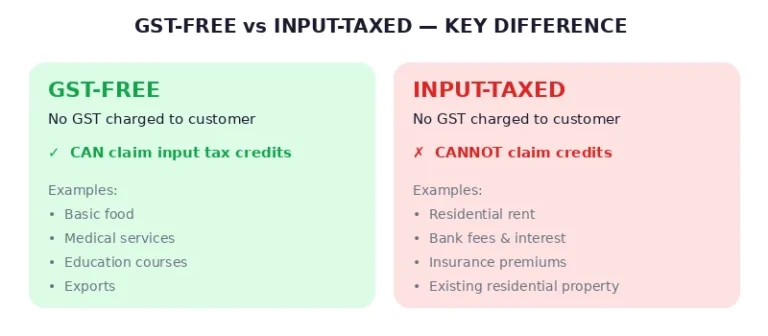
Two categories, both with no GST on the price tag. From the customer’s side they look identical. From the business side they’re worlds apart.
|
Feature |
GST-Free |
Input-Taxed |
|---|---|---|
|
GST charged to customer |
No |
No |
|
Claim input tax credits? |
Yes ✓ |
No ✗ |
|
Examples |
Food, health, education |
Residential rent, financial services |
|
Impact on business |
Neutral — you still get credits |
Negative — you absorb GST on expenses |
Sell GST-free goods — say you run a fruit shop — and you can still claim back the GST built into your rent, refrigeration, delivery van and shelving. The exemption costs you nothing.
But rent out a residential property? That’s input-taxed. No GST on the rent, and no credits on your expenses either. The GST inside your agent fees, repairs and maintenance just becomes part of your cost base. Same “no GST” label on the invoice. Very different economics underneath.
What is the difference between GST-free and input-taxed?
Both have no GST charged, but with GST-free supplies you can still claim input tax credits on your business purchases. With input-taxed supplies (residential rent, bank fees, financial services), you cannot claim those credits — you absorb the GST cost.
Common Questions