Do I Need to Register for GST as a Sole Trader?
You don’t need to register for GST as a sole trader unless your business turns over $75,000 or more in a rolling 12-month period. Under that, it’s optional. Over it, you’ve got 21 days to register or the ATO can hit you with backdated GST and penalties.
That part is straightforward. What trips up most sole traders isn’t the rule itself — it’s when. The $75,000 threshold doesn’t work the way most people think it does, and the ATO’s definition of “turnover” catches thousands of sole traders off guard every year.
Our complete GST registration guide covers the full step-by-step process for all business types. This post focuses on the sole trader angle — what counts as turnover, how to track it, and the mistakes that cost real money.
KEY FACTS AT A GLANCE
📌 Threshold: $75,000 GST turnover in any rolling 12-month period
📌 Deadline: 21 days to register after hitting or expecting to hit the threshold
📌 Turnover = gross business income, not profit (expenses don’t reduce it)
📌 Rideshare/taxi: must register from dollar one, no threshold applies
📌 Under $75K: registration is optional but can benefit B2B sole traders
GST Turnover Is Your Gross Income, Not Your Profit
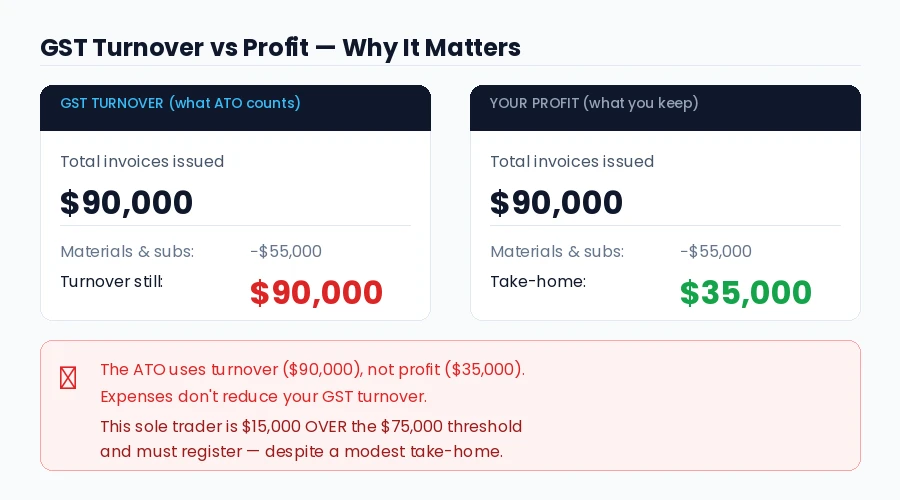
This is the single biggest misunderstanding in sole trader GST registration, and it burns people every year. The ATO defines GST turnover as your gross business income. Not your taxable income. Not your take-home pay. Not what’s left after you pay subcontractors, buy materials, or cover rent.
A sole trader electrician who invoices $90,000 and spends $55,000 on materials, a ute, and an apprentice still has a GST turnover of $90,000. The expenses don’t reduce it. That electrician is well over the $75,000 threshold — even though their actual profit is only $35,000.
✅ Counts toward $75K
All taxable business sales
GST-free sales (still count)
All business income streams
❌ Doesn’t count
Salary/wages from employment
Investment/dividend income
Residential rental income
If you sell a mix of taxable and GST-free items, both types count toward the threshold. And one more detail: turnover is calculated excluding the GST component. So if you’re already registered and invoice $110 (including $10 GST), only $100 counts.
How the Rolling 12-Month Test Works
The $75,000 threshold doesn’t reset on 1 July. It applies to any rolling 12-month period — the ATO looks backwards and forwards. Two tests run at the same time, and you must register if either one triggers.
Current turnover: add up this month plus the previous 11 months. If the total hits $75,000, register.
Projected turnover: estimate this month plus the next 11 months. If it’s likely to hit $75,000, register now — even if your backwards-looking number is still under.
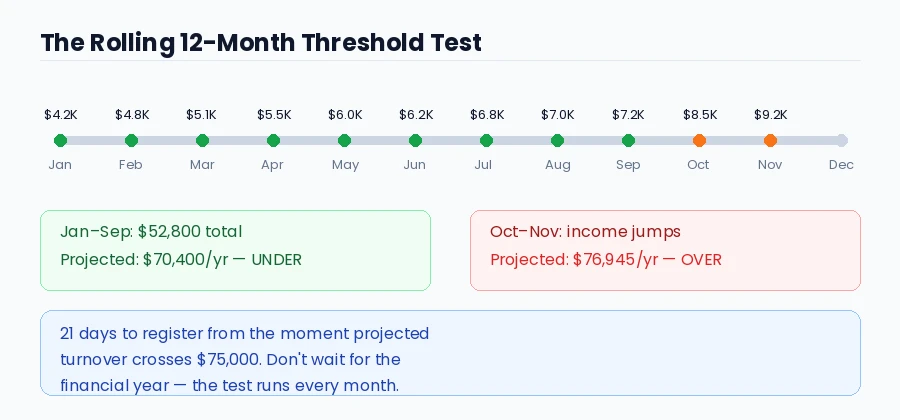
That projected test is the one that catches people. You don’t wait until you’ve actually crossed $75,000 in the rear-view mirror. If you sign a new contract or pick up regular clients that push your expected annual income past the threshold, your obligation starts the moment you know.
WORKED EXAMPLE — SARAH’S BOOKKEEPING BUSINESS
Sarah started a home-based bookkeeping business in Brisbane in January. Monthly income: Jan $4,200 · Feb $4,800 · Mar $5,100 · Apr $5,500 · May $6,000 · Jun $6,200 · Jul $6,800 · Aug $7,000 · Sep $7,200.
By September (9 months), she’s earned $52,800. Projected annual: $52,800 ÷ 9 × 12 = $70,400. Under the threshold.
October: two new clients push income to $8,500. Projected: $73,560. Close, but still under.
November: income hits $9,200. Projected: $76,945. Over the threshold.
Sarah has 21 days from end of November to register. From her registration date, every invoice includes GST.
The key detail: Sarah didn’t wait for a full 12 months of history. She used projected turnover — exactly what the ATO expects. To understand the maths behind GST calculations, our guide to calculating GST covers every formula.
When Voluntary Registration Makes Sense
Under $75,000? Registration is optional. But for some sole traders it’s the smarter move. The answer depends on who your clients are.
👔 Your clients are businesses
They claim your GST back — your price doesn’t change for them
You look more established and professional
You claim GST credits on your business purchases
→ Register voluntarily
👤 Your clients are consumers
They can’t claim GST back — you become 10% more expensive
Price-sensitive clients may go to unregistered competitors
Admin burden: BAS lodgement, record keeping
→ Stay unregistered until $75K
One thing to know: once you register voluntarily, you’re locked in for at least 12 months. Our registration guide covers voluntary registration and the cancellation process in detail.
What Changes the Day You Register
🧾
Tax invoices
Every invoice becomes a tax invoice. A $1,000 job becomes $1,100. The $100 GST isn’t your income — it belongs to the ATO. Use our GST calculator to work out any amount.
💰
GST credits
Claim back the GST on business purchases — tools, software, fuel, insurance, accounting fees. If credits exceed GST collected, the ATO refunds the difference.
📊
Quarterly BAS
Four times a year, report GST collected minus credits claimed. Our BAS guide covers due dates and lodgement.
📁
5-year records
Tax invoices, bank statements, receipts — keep everything for five years. Cloud software like Xero or MYOB handles this automatically.
Five Mistakes That Cost Sole Traders Money
1. Confusing turnover with profit
Your gross income is $82,000 but after expenses your profit is $28,000. Doesn’t matter — you’re over the threshold. The ATO doesn’t care about your expenses when calculating GST turnover. This is the mistake that leads to late registration penalties more than any other.
2. Only checking turnover once a year
The threshold is rolling, not financial-year based. A strong quarter can push your rolling total past $75,000 in any month. Check on the first of every month — it takes two minutes and could save you thousands.
3. Spending the GST money
You invoice $1,100 and see $1,100 in your bank account. But $100 of that is the ATO’s. Open a separate bank account, transfer 1/11th of every payment into it, and don’t touch it. Sole traders who treat GST as income get a shock when BAS is due.
4. Not claiming GST credits
Some sole traders charge GST on sales but forget to claim back the GST on their purchases. Every business expense with GST on the receipt is claimable — fuel, phone bills, internet, tools, insurance, accounting fees. Leaving credits unclaimed is giving money away.
5. Putting “Tax Invoice” on invoices before registering
If you’re not registered for GST, your invoices must say “Invoice” — never “Tax Invoice.” And you can’t include a GST line item either. Misrepresenting your tax status is a compliance issue the ATO takes seriously.
Frequently Asked Questions
Do I pay GST on everything once I register, or just income above $75,000?
Everything. Once registered, you charge 10% GST on all taxable sales from your registration date — not just the income above $75,000. There’s no GST-free threshold the way there is for income tax. Dollar one of your next invoice includes GST.
What if my turnover drops below $75,000 after I register?
You can apply to cancel your GST registration, but only after you’ve been registered for at least 12 months. If you registered voluntarily, the same 12-month minimum applies.
Does my salary from a day job count toward the $75,000?
No. Only income from your business activities counts toward GST turnover. Wages from employment, investment income, residential rental income, and personal income are all excluded. If you earn $60,000 as an employee and $40,000 from your side business, your GST turnover is $40,000.
Can the ATO really make me pay GST I never collected from customers?
Yes. If you should have registered but didn’t, the ATO can backdate your registration. You’ll owe 1/11th of every sale made between the date you should have registered and the date you actually did — even though you never added GST to those invoices. On $30,000 in sales over three months, that’s roughly $2,727 out of your own pocket.
Do I add GST on top of my prices or absorb it?
Most sole traders add 10% on top — a $100 service becomes $110. If your clients are businesses, they claim the $10 back anyway so it doesn’t cost them extra. If your clients are consumers, some sole traders absorb the GST to stay competitive, but that means you only keep $90.91 of every $100 invoice.
I drive for Uber part-time. Do I need to register?
Yes — from your first dollar. Taxi, limousine, and rideshare drivers must register for GST regardless of turnover. The $75,000 threshold doesn’t apply. Even a few hours on weekends triggers the obligation. Our registration guide covers this in detail.
What’s the difference between an ABN and GST registration?
An ABN identifies your business. GST registration is a separate step that means you’re collecting and remitting GST. You need an ABN before you can register for GST, but having an ABN doesn’t automatically mean you’re GST-registered. They’re two different things.
How do I actually register once I need to?
Online through the ATO’s Business Portal — it takes about 10 minutes if you already have an ABN. Our step-by-step registration guide walks through the full process including choosing your reporting frequency and accounting method.