
What Is Input Tax Credit? How to Claim GST Back on Business Purchases
An input tax credit is the GST included in the price of something you buy for your business. If you’re GST-registered, you claim that GST back from the ATO through your BAS. Buy $550 worth of office supplies (including $50 GST), and that $50 comes back to you. It reduces your GST bill — or turns it into a refund if your credits exceed the GST you collected from customers.
Every GST-registered business in Australia is entitled to claim input tax credits. But not every purchase qualifies, not every receipt is enough proof, and the mistakes people make when claiming cost real money. Some businesses overclaim and trigger ATO reviews. Others leave thousands of dollars in unclaimed credits sitting on the table because they didn’t know the rules.
Our guide to how GST works covers the basics of the tax itself. This post goes deeper on the credit side — what you can claim, what you can’t, the $82.50 tax invoice rule, and how to report it on your BAS.
THE FOUR CONDITIONS (ATO)
1. You must be registered for GST
2. The purchase must be for a business purpose (not private)
3. The price must actually include GST
4. You must have a tax invoice for purchases over $82.50
How Input Tax Credits Work — The Cycle
The GST system works on a collect-and-credit loop. You charge 10% GST on what you sell (that’s your output tax). You pay 10% GST on what you buy for the business (that’s your input tax). Every quarter, you report both numbers on your BAS. The difference is what you owe — or what you’re owed.
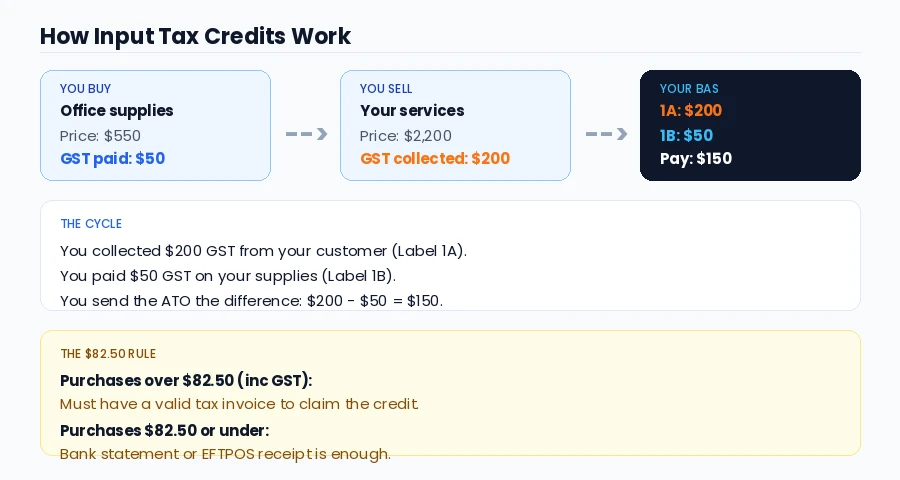
Label 1A on your BAS is the GST you collected from customers. Label 1B is the GST you paid on business purchases. Net GST = 1A minus 1B. If 1A is bigger, you pay the ATO. If 1B is bigger, the ATO refunds you. Our divide-by-11 guide shows how to calculate both figures from any GST-inclusive amount.
What You Can Claim GST Credits On
Any business expense where the supplier charged you GST is potentially claimable. The list is broader than most people think.
WORKED EXAMPLE — QUARTERLY CREDITS
A graphic designer’s business purchases in Q3 (Jan–Mar):
Adobe subscription: $660 (GST: $60)
New monitor: $1,100 (GST: $100)
Phone plan: $110/month x 3 = $330 (GST: $30)
Accounting fees: $550 (GST: $50)
Total GST credits: $60 + $100 + $30 + $50 = $240
That $240 goes on Label 1B and reduces the GST bill on the BAS.
Overseas software and cloud services follow slightly different rules. See how GST on overseas subscriptions works for Australian businesses.
For commercial property purchases, the GST credit rules have some extra considerations. See how GST works on different property types in Australia.
What You Can’t Claim GST Credits On
Not every expense with a dollar sign on it includes GST. And not every GST-inclusive expense qualifies for a credit.
NO GST INCLUDED (can’t claim)
Wages and salaries
Bank fees and interest
Council rates
Government charges and stamp duty
Purchases from suppliers not registered for GST
INPUT-TAXED (can’t claim)
Residential rent
Financial services (loans, mortgages)
Life insurance premiums
Purchases related to making input-taxed supplies
The most common trap: assuming every expense has GST. A sole trader sees a $100 bank fee and tries to claim $9.09 GST on it. But bank fees are input-taxed — there’s no GST in the price. Same with wages, government charges, and purchases from unregistered suppliers. If no GST was charged, there’s no credit to claim. Check the receipt or invoice before reporting it.
The $82.50 Tax Invoice Rule
The ATO draws a line at $82.50 (including GST). Above that number, you need a valid tax invoice to claim the credit. Below it, a bank statement, EFTPOS receipt, or cash register docket is enough.
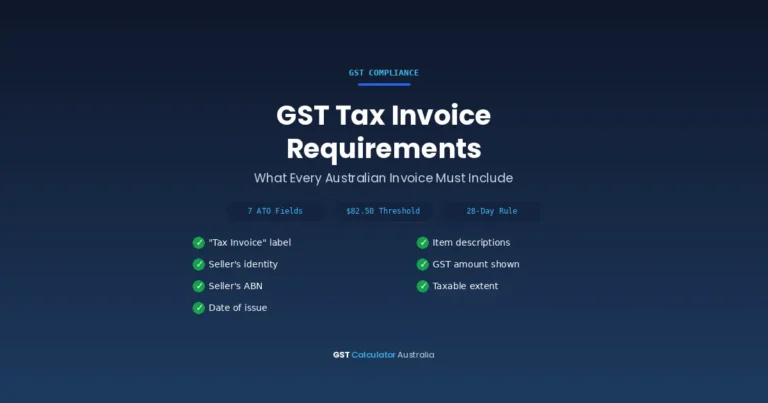
A valid tax invoice must show: the words “Tax Invoice,” the supplier’s name and ABN, the date, a description of what was sold, the GST amount or a statement that the total includes GST, and the total price. For invoices over $1,000, it also needs your business name or ABN. Our GST tax invoice requirements guide has the full ATO checklist.
Missing a tax invoice? Ask the supplier. They’re required to provide one within 28 days of your request. But don’t claim the credit until you have it — claiming without a valid invoice for purchases over $82.50 is a compliance issue the ATO takes seriously.
Mixed-Use Purchases — Claiming the Business Portion
If you use something for both business and personal purposes, you can only claim the business portion of the GST. A phone used 70% for work and 30% for personal calls? Claim 70% of the GST. A car used half for business and half for private driving? Claim 50%.
The ATO expects a reasonable method of apportionment. For vehicles, a logbook kept for at least 12 weeks is the gold standard. For phones and internet, a usage diary over a representative period. For a home office, the percentage of floor space used exclusively for business.
The adjustment rule
If you claimed a credit based on planned business use but your actual use turns out different, you need to adjust. Claimed 80% business on a laptop but actually use it 50%? You owe the ATO the GST credit on the 30% difference. It works the other way too — if actual business use is higher than claimed, you can pick up the extra credit on a later BAS.
The 4-Year Time Limit
Forgot to claim a GST credit on a purchase from two years ago? You can still claim it. The ATO allows you to claim input tax credits up to four years after the end of the tax period in which the credit arose. So a purchase from October 2024 can be claimed until the end of the October 2028 BAS period.
Just report it on your next BAS at Label 1B. No need to amend the original BAS — add it to the current period and the ATO accepts it. But after four years, the credit expires. If you’re behind on your bookkeeping, this is a good reason to catch up.
How to Report Credits on Your BAS
GST credits go on Label 1B of your BAS. Add up the GST component of all eligible business purchases for the quarter, and that total goes in the 1B box. Use our GST calculator to find the GST in any GST-inclusive amount — or divide each receipt total by 11.
Net GST = Label 1A (GST collected on sales) minus Label 1B (GST paid on purchases). If 1A is bigger, you pay the difference. If 1B is bigger — maybe you bought a ute or a big piece of equipment — the ATO sends you a refund. Refunds typically arrive within 14 days of electronic lodgement.
Common Claiming Mistakes
1. Claiming GST on purchases that don’t include GST
The single most common error. A $100 expense doesn’t automatically contain $9.09 GST. Bank fees, wages, council rates, government charges, and purchases from unregistered suppliers have no GST in them. Check the invoice — if there’s no GST line or “includes GST” statement, there’s nothing to claim.
2. Not claiming at all
Some sole traders and small business owners focus on reporting GST collected but forget to claim GST on purchases. Every unclaimed credit is money you’re entitled to but leaving on the table. A business spending $8,000 a month on GST-inclusive expenses is entitled to roughly $727 a month back.
3. Claiming the full GST on mixed-use items
A phone used 60% for business and 40% for personal calls means you can claim 60% of the GST — not the full amount. The ATO audits for this, especially on vehicles, phones, and home internet. Keep a logbook or usage record as evidence.
4. Claiming without a valid tax invoice
For purchases over $82.50, the ATO requires a tax invoice — not just a bank statement. If the supplier didn’t give you one, request it. You have the right to ask, and they must provide it within 28 days. Claim the credit in a later BAS period if the invoice arrives after you’ve already lodged.
These four errors overlap with a bigger pattern. Our guide to the most common BAS mistakes covers all seven errors the ATO flags, including penalties and how to fix each one.
Frequently Asked Questions
What is an input tax credit in simple terms?
It’s the GST you paid on a business purchase that you get back from the ATO. Buy something for $110 including $10 GST, and that $10 is your input tax credit. You report it on your BAS, and it reduces the GST you owe — or the ATO refunds you if your credits are bigger than what you collected.
Do I need to be GST-registered to claim input tax credits?
Yes. Only GST-registered businesses can claim input tax credits. If you’re not registered, the GST you pay on purchases is just part of the cost. Once you register for GST, you start claiming credits from that date forward.
What’s the $82.50 rule?
For purchases over $82.50 (including GST), the ATO requires a valid tax invoice before you can claim the GST credit. For purchases of $82.50 or less, other evidence like a bank statement or EFTPOS receipt is accepted.
Can I claim GST on petrol?
Yes — fuel includes GST. But if you use the vehicle for both business and personal driving, you can only claim the business-use portion. Keep a logbook for at least 12 weeks to establish your business-use percentage.
What if I forgot to claim a GST credit?
You can claim it on a later BAS, up to four years after the original tax period. Just add it to Label 1B on your next return. No need to amend the earlier BAS.
Can I claim GST on food and coffee?
Only if GST was charged. A hot coffee from a café includes GST — so yes, the GST is claimable as a business expense if the coffee was for a client meeting or business purpose. Basic grocery food is GST-free, so there’s no GST to claim on those items.
Do I get a refund if my credits are bigger than my GST collected?
Yes. If Label 1B (credits) exceeds Label 1A (GST collected), the ATO refunds the difference. This happens often when a business makes a large purchase — buying a vehicle, equipment, or fit-out — and the GST on that purchase is more than the GST collected on sales for the quarter.
Can I claim GST on rent?
Commercial rent — yes. Your landlord charges GST on commercial premises, and you can claim that GST back on your BAS. Residential rent — no. Residential rent is input-taxed, meaning no GST is charged and no credit can be claimed.
3 Comments
Comments are closed.