GST on Overseas Subscriptions and Digital Services in Australia
Yes, most overseas digital subscriptions include 10% Australian GST. Since 1 July 2017, overseas companies like Netflix, Spotify, Adobe and Microsoft have been required to charge GST when selling digital products to Australian consumers. The rule applies even though the supplier has no office, staff or servers in Australia.
But the rules work differently depending on whether you’re buying as a regular consumer or as a GST-registered business. That distinction changes everything: who pays the GST, whether you can claim it back, and what needs to appear on the invoice.
Quick answer
If you’re an Australian consumer (not GST-registered), you’ll pay 10% GST on overseas digital subscriptions at checkout. If you’re a GST-registered business, the overseas supplier shouldn’t charge you GST when you provide your ABN and confirm your registration. You can’t claim GST credits on an invoice that doesn’t show Australian GST.
What Counts as an Imported Digital Service?
The ATO uses the term “inbound intangible consumer supplies.” In plain English, that’s anything delivered electronically from an overseas supplier to an Australian buyer. The list is wider than most people expect:
Streaming
Video, music, sports, podcasts
Software and SaaS
Design tools, accounting, project management
Cloud services
Storage, hosting, servers, backups
Online advertising
Search ads, social media ads, marketplace ads
Apps and games
Mobile apps, game codes, in-app purchases
Digital downloads
E-books, templates, stock photos, music
Online learning
Courses, webinars, membership platforms
Remote services
Consulting, design, legal, technical support
This is different from physical goods arriving through customs. Imported goods have separate rules involving customs value and duties. This guide only covers digital services and products delivered electronically.
The ATO’s guidance on imported services and digital products has the full list.
Consumer vs Business: Why It Matters
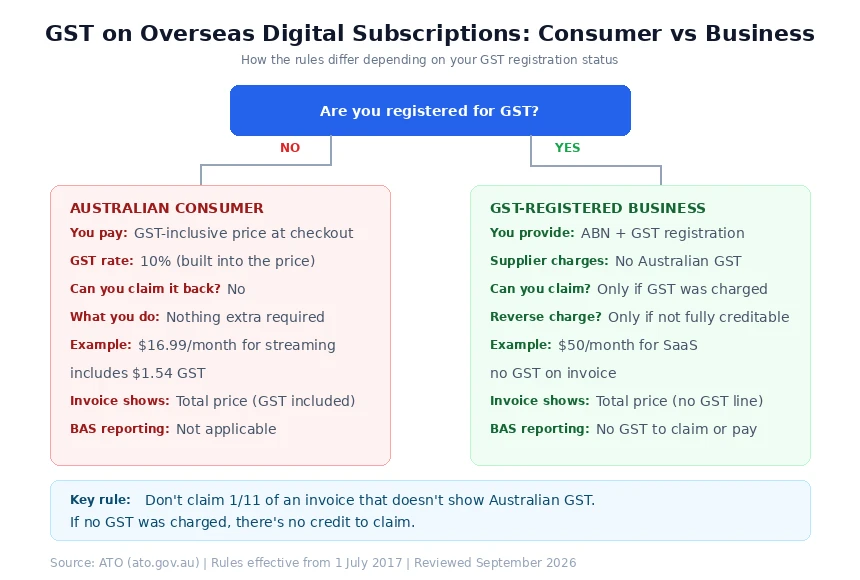
The GST treatment of overseas digital purchases comes down to one question: are you buying as an Australian consumer, or for a GST-registered business?
Australian consumer
You’re not registered for GST, or you’re buying for personal use.
The overseas supplier charges you 10% GST at checkout. You pay the GST-inclusive price. You can’t claim it back.
GST-registered business
You provide your ABN and confirm you’re GST-registered.
The overseas supplier should not charge GST. You may need to self-assess under the reverse charge rules if the purchase isn’t fully creditable.
The overseas supplier uses your ABN and GST registration statement to work out which category you fall into. And this is where people trip up: having an ABN doesn’t mean you’re registered for GST. They’re two different things. Our guide on ABN vs GST registration explains the difference.
How It Works for Consumers (Personal Subscriptions)
If you’re not registered for GST and you subscribe to Netflix, Spotify, Adobe Creative Cloud or any other overseas digital service for personal use, the price you see at checkout already includes 10% Australian GST. The overseas company collects it and sends it to the ATO.
You don’t need to do anything extra. You can’t claim the GST back. It’s built into the price you pay, just like GST on a coffee or a haircut.
This has been the case since 1 July 2017, when the ATO started requiring overseas digital suppliers to register for Australian GST once their sales to Australian consumers hit $75,000 per year. Some people call it the “Netflix tax,” but it covers far more than streaming.
How It Works for GST-Registered Businesses
This is where it gets more interesting. If you run a GST-registered business and you buy overseas software, cloud services or advertising, the rules change.
When you give the overseas supplier your ABN and confirm you’re GST-registered, they should not charge you Australian GST. The ATO’s guidance for Australian businesses is clear on this: “If you are an Australian GST-registered business and you import services, digital products or low valued imported goods, you shouldn’t be charged GST.”
So what happens instead? Three possible outcomes:
Supplier charges GST anyway (some platforms can’t distinguish business from consumer at checkout). You can seek a refund by providing your ABN and GST registration details. Or, if you hold a valid tax invoice and the purchase is for business, you may be able to claim a GST credit on your BAS.
Supplier doesn’t charge GST and the purchase is fully for your taxable business. No GST to pay, no GST to claim. The expense is still deductible for income tax purposes.
Reverse charge applies. If the purchase is partly private or supports input-taxed activities (like residential rental income), you may need to self-assess and pay GST under the reverse charge rules. More on this below.
The key mistake to avoid: don’t calculate 1/11 of an overseas invoice and claim it as a GST credit when the invoice doesn’t show Australian GST. If no GST was charged, there’s nothing to claim.
The Reverse Charge: When You Self-Assess GST
The reverse charge is the rule most people find confusing. Here’s what it actually means.
Normally, the supplier charges GST. Under the reverse charge, the buyer (you) calculates and pays the GST instead. It applies when a GST-registered Australian business imports a service and wouldn’t be entitled to claim a full GST credit on it.
When does that happen? Two common scenarios:
Mixed business and private use
You buy cloud storage for $220 and use it 60% for business, 40% personal. The 40% private portion isn’t creditable, so you’d self-assess 10% GST on that non-creditable portion.
Input-taxed activities
Your business earns residential rental income (input-taxed) and buys overseas software to manage the properties. The purchase supports input-taxed supplies, so the reverse charge may apply.
If you buy overseas software and use it 100% for your taxable business, the reverse charge generally doesn’t apply. You wouldn’t have owed GST, and you would have been entitled to a full credit anyway, so the net effect is zero.
Because the reverse charge depends on how the service is used, talk to your accountant if an overseas purchase supports input-taxed sales, private use or another non-creditable activity.
Worked Examples
Mia: personal streaming subscription
Mia subscribes to a streaming service for personal use. She’s not GST-registered. The overseas provider charges her a GST-inclusive price. Mia pays the advertised amount and can’t claim any GST credit because the subscription is private.
Noah: business software with GST on the invoice
Noah runs a GST-registered design business and buys overseas design software for $55/month including $5 GST. The invoice clearly shows Australian GST. He uses it entirely for business. Noah claims the $5 GST credit on his BAS each month, provided he holds the invoice.
Amelia: overseas supplier charges no GST
Amelia’s GST-registered consultancy buys a cloud tool from an overseas supplier. She’s provided her ABN and confirmed her GST registration. The invoice shows $50/month with no GST. Amelia records the expense but does not calculate 1/11 of the payment and claim it as GST. There’s no Australian GST on the invoice, so there’s nothing to claim.
Ethan: mixed business and private use
Ethan pays $33 including $3 GST for cloud storage. He uses it 60% for his GST-registered business and 40% for personal files. His potential GST credit is limited to the business portion: $3 x 60% = $1.80. He keeps a record of how he calculated the split.
How to Check Before You Claim
Run through this for every overseas subscription before reporting it on your BAS:
Open the actual invoice. A bank or card statement doesn’t show enough GST detail. Download the invoice from the supplier’s billing portal.
Check the billing entity. A familiar international brand might bill Australian customers through a local subsidiary or through an overseas company registered for Australian GST. The entity on the invoice determines the GST treatment.
Look for Australian GST. Check for a GST amount, a “total includes GST” statement, or the supplier’s ABN or ATO Reference Number (ARN). If none of these appear, don’t assume GST was charged.
Confirm business use. Separate any private use. If it’s a mixed-use subscription, work out the business percentage and document how you calculated it.
Keep the invoice. Retain it with your BAS records. Subscription renewals can change billing entities or GST treatment between periods, so check each invoice rather than copying last month’s treatment.
If GST is included in a GST-inclusive price, the GST component is the total divided by 11. Our explanation of the divide-by-11 method shows why this works, or use our GST calculator for an instant answer.
What About App Store Purchases?
When you buy an app through Apple’s App Store or Google Play, the platform operator (Apple or Google) is usually responsible for collecting and remitting the GST to the ATO. Not the individual app developer.
So the GST treatment is determined by the platform’s billing entity and your account settings, not by where the developer is based. This is the ATO’s electronic distribution platform (EDP) rule. It simplifies things for smaller overseas developers by shifting the GST responsibility to the platform.
Record Keeping for Overseas Subscriptions
Keep records that show:
Invoice and proof of payment
Supplier and billing entity name
Currency and AUD conversion used
Whether Australian GST was charged
Business purpose of the subscription
Private-use adjustment (if any)
Our guide to GST tax invoice requirements covers what the ATO expects on each document. Keep in mind that overseas suppliers using the ATO’s simplified GST registration get an ATO Reference Number (ARN) instead of an ABN, so their invoices look slightly different from a local supplier’s.
Frequently Asked Questions
Do overseas subscriptions include Australian GST?
In most cases, yes. Since 1 July 2017, overseas suppliers must charge 10% GST when selling digital services to Australian consumers. The rule applies to streaming, software, cloud services, apps, online advertising and other digital products. Check your invoice to confirm whether GST was charged on your specific purchase.
Can I claim GST on overseas software for my business?
You can claim a GST credit if you’re registered for GST, the purchase is for a creditable business purpose, Australian GST was actually charged, and you hold the required documentation. You can’t claim 1/11 of an invoice that shows no Australian GST. If the supplier didn’t charge GST after you provided your ABN, there’s no credit to claim. Our input tax credit guide covers the full eligibility rules.
Does entering my ABN remove GST from an overseas subscription?
Not automatically. An ABN and GST registration are separate things. The overseas supplier uses your ABN and your confirmation that you’re GST-registered to decide whether you’re an Australian consumer. If you have an ABN but aren’t registered for GST, providing your ABN alone won’t change the GST treatment.
Is GST charged on Google Ads and Facebook Ads in Australia?
It depends on the billing entity and your account settings. Both platforms have Australian billing entities that charge GST. Check your account’s tax settings, confirm your ABN and GST registration details are entered correctly, and review each invoice for the GST treatment applied.
What is the reverse charge for overseas digital services?
The reverse charge is when the buyer (not the supplier) accounts for GST. It applies when a GST-registered Australian business imports a service and wouldn’t be entitled to a full GST credit, for example because the purchase is partly private or supports input-taxed supplies. If the purchase is 100% for your taxable business, the reverse charge generally doesn’t apply. Talk to your accountant if you’re unsure.
Is a bank statement enough to claim GST on an overseas subscription?
No. A bank statement proves payment but doesn’t show the GST information needed to support a credit. Download the actual invoice from the supplier’s billing portal. It should show whether Australian GST was charged, the GST amount, and the supplier’s ABN or ARN.
Do the same rules apply to physical goods from overseas?
No. Physical goods entering Australia follow separate rules for customs value, duties and low-value imported goods (under $1,000). This guide covers only digital services and products delivered electronically.
Disclaimer: This guide is general information only, current as at September 2026. It is not financial, tax or legal advice. GST rules can change, and individual circumstances vary. The reverse charge rules in particular depend on how a service is used. Consult a registered tax agent or BAS agent, or contact the ATO directly, for advice about your specific situation.