
GST Tax Invoice Requirements — What Every Australian Invoice Must Include
A valid Australian tax invoice must include seven specific details set by the ATO. Miss even one, and your customer can’t claim their GST credit — which means an awkward phone call and a potential hold-up at BAS time. Here’s exactly what the ATO expects, the thresholds that change the rules, and the mistakes that trip up businesses every quarter.
What Makes a Tax Invoice Different From a Regular Invoice?
They look similar, but they’re not the same thing. A regular invoice just asks for payment. A tax invoice does that and documents the GST so the buyer can claim a credit. That distinction matters because the ATO treats them differently.
If you’re registered for GST, you issue tax invoices for taxable sales. If you’re not registered, you issue plain invoices — and you must not label them “Tax Invoice” or show any GST. Doing so when you’re not registered is a compliance breach, even if it’s accidental.
The practical difference? A buyer who receives a proper tax invoice can claim the GST back through their BAS. A buyer who gets a plain invoice (or a tax invoice with missing details) can’t. So your invoice isn’t just a bill — it’s the document that unlocks your customer’s input tax credit.
The 7 Fields the ATO Requires on Every Tax Invoice
For any taxable sale of $82.50 or more (including GST), the ATO says a tax invoice must show these seven things:
The words “Tax Invoice”
Displayed prominently — usually at the top. Without these exact words, it’s just an invoice.
The seller’s identity
Your business name or trading name. Contact details are optional but recommended.
The seller’s ABN
Your 11-digit Australian Business Number. If you don’t quote an ABN, the buyer may be legally required to withhold 47% of the payment and send it to the ATO.
The date of issue
When the invoice was created — not the date the work was done or the goods delivered. That catches people out.
A description of what was sold
Each item or service, including the quantity and the price. “Professional services” on its own is too vague.
The GST amount
Shown separately for each line item, or as a single statement like “Total price includes GST.” Either approach works — more on that below.
The extent to which each sale is taxable
Which items carry GST and which are GST-free. This matters most on invoices that mix taxable and non-taxable items.
That’s the full checklist. And no — an invoice number isn’t one of the seven ATO-mandated fields. But it’s standard practice and exactly what an auditor looks for, so you should include one anyway.
The Two Thresholds That Change the Rules
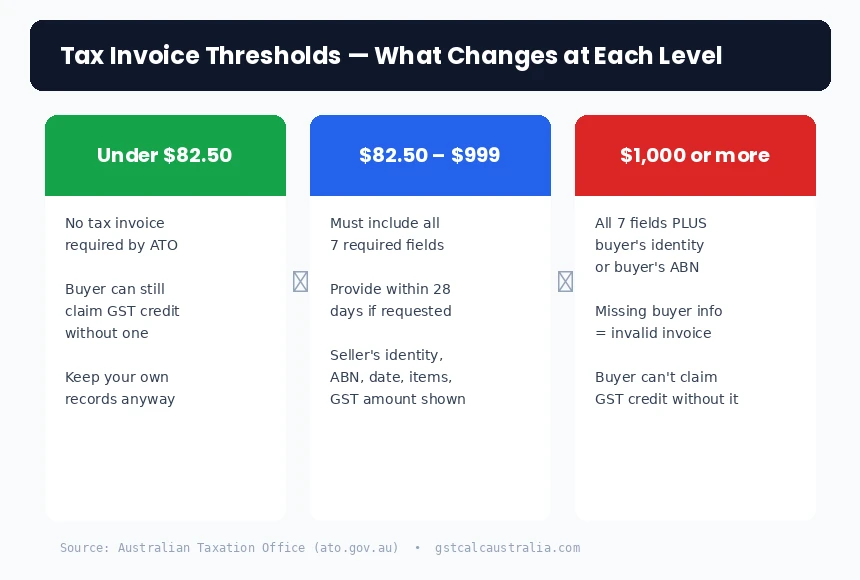
Not every sale needs a tax invoice. The ATO draws two lines in the sand, and each one changes what you have to do.
Under $82.50 (incl. GST)
No tax invoice required. Your customer can still claim a GST credit without one. But keep your own records — the ATO can ask.
$1,000 or more (incl. GST)
All 7 standard fields plus the buyer’s identity or the buyer’s ABN. Leave that off and the whole invoice is technically invalid.
Where does $82.50 come from? It’s simply $75 plus 10% GST. And the $1,000 threshold exists because the ATO wants a paper trail linking both parties on bigger transactions.
A quick example: an electrician invoices $2,200 for a switchboard upgrade. That’s over $1,000, so the invoice needs the customer’s name or ABN on it. Without that detail, the customer’s accountant can’t process the GST credit — and it’ll bounce right back.
For sales between $82.50 and $999.99, the standard seven fields are enough. No buyer details needed.
Two ATO-Approved Ways to Show GST on Your Invoice
The ATO accepts two methods for displaying the GST amount. Both are valid — pick whichever suits your invoicing setup.
Method 1 — Line-by-line GST
Each line item shows its GST component separately. Best when your invoice mixes taxable and GST-free items, because the tax treatment of each item is obvious at a glance.
Method 2 — Total GST statement
A single GST figure at the bottom, or a statement like “Total price includes GST of $X.” Works well when every item on the invoice is taxable at 10%.
Either way, the GST must equal exactly one-eleventh of the total price. You can use our GST calculator to double-check the split. Getting the maths wrong is one of the most common reasons invoices fail an ATO review.
The 28-Day Rule Most Businesses Don’t Know About
Here’s one that surprises people: if a customer asks for a tax invoice, you must provide it within 28 days. That’s an ATO requirement, not just good practice.
Many businesses issue tax invoices automatically for every taxable sale — and that’s the smarter approach. It keeps your records clean and means you never have to scramble to produce one when a customer or their accountant calls three weeks later.
But the 28-day clock only ticks for sales of $82.50 or more. Below that, you’re not required to issue one at all, even if the customer asks.
What If You’re Not Registered for GST?
If your annual turnover is under $75,000 (or $150,000 for non-profits) and you haven’t registered voluntarily, you don’t charge GST — and you don’t issue tax invoices. Period.
Your invoices should be labelled “Invoice” (not “Tax Invoice”) and must not show any GST amount. If you accidentally label an invoice as a tax invoice when you’re not registered, you’ve created a compliance problem. The ATO can treat it as if you’ve charged GST you haven’t remitted.
Not sure whether you need to register? Our guide on ABN vs GST registration walks through the decision.
And if your turnover crosses the $75,000 threshold, you’ve got 21 days to register. From that point, you’ll need to start issuing proper tax invoices and lodging BAS returns to report your GST.
Common Mistakes That Invalidate a Tax Invoice
These are the errors the ATO (and your customers’ accountants) see over and over:
❌ Labelling it “Invoice” instead of “Tax Invoice”
If the document doesn’t say “Tax Invoice,” it isn’t one — regardless of whether GST is shown.
❌ Missing or incorrect ABN
The buyer may be forced to withhold 47% under the no-ABN withholding rules. Always double-check your 11 digits.
❌ Vague item descriptions
“Consulting” or “services rendered” isn’t enough. The ATO wants to see what was actually supplied.
❌ Using the work date instead of the issue date
The date on the invoice is when the invoice was created, not when you did the job.
❌ Leaving buyer details off invoices of $1,000+
The biggest quiet failure. The invoice looks complete, but without the buyer’s name or ABN on a large sale, it’s technically non-compliant.
❌ Issuing a tax invoice when you’re not GST-registered
This one can trigger penalties. If you’re under the $75,000 threshold and haven’t registered, your invoices should never say “Tax Invoice.”
Invoice errors are just one piece of the puzzle. Our guide to the 7 most common BAS mistakes covers late lodgement, wrong GST codes, and five other errors that cost businesses penalties every quarter.
Recipient-Created Tax Invoices — The Exception
Normally, the seller issues the tax invoice. But there’s an exception called a recipient-created tax invoice (RCTI), where the buyer issues it instead.
Both parties need to be GST-registered, and they must have a written agreement in place. The ATO allows this when it’s more practical for the buyer to create the invoice — common in industries like agriculture, mining, and some government contracts.
RCTIs follow the same seven-field rules, but the document must be labelled “Recipient Created Tax Invoice” and the seller must not issue their own tax invoice for the same sale. That would create a duplicate, which throws the GST reporting out on both sides.
Most small businesses won’t need RCTIs. But if a large customer or government body asks you to sign an RCTI agreement, it’s worth knowing what it means.
How Long to Keep Your Tax Invoices
The ATO requires you to keep tax invoices — both the ones you issue and the ones you receive — for at least five years from the date you made the record or the transaction was completed, whichever is later.
Digital copies are fine. The ATO accepts electronic records as long as they’re legible and accessible. Most accounting software (Xero, MYOB, QuickBooks) stores them automatically, but it’s worth checking that your backups go back the full five years.
Frequently Asked Questions
What are the 7 things a tax invoice must include in Australia?
The ATO requires: (1) the words “Tax Invoice,” (2) the seller’s identity, (3) the seller’s ABN, (4) the date of issue, (5) a description of items sold including quantity and price, (6) the GST amount or a statement that the total includes GST, and (7) the extent to which each sale is taxable.
Do I need to issue a tax invoice for sales under $82.50?
No. For taxable sales under $82.50 (including GST), the ATO doesn’t require a tax invoice. Your customer can still claim a GST credit without one. But you should still keep records of the sale for your own BAS reporting.
What extra detail is needed on invoices of $1,000 or more?
For sales of $1,000 or more (including GST), the invoice must include all 7 standard fields plus the buyer’s identity (their name) or the buyer’s ABN. Without this, the invoice is technically non-compliant and the buyer can’t claim their GST credit.
What’s the difference between a tax invoice and a regular invoice?
A regular invoice requests payment. A tax invoice requests payment and documents the GST, which lets the buyer claim a GST credit. Only GST-registered businesses can issue tax invoices. If you’re not registered, you issue a plain “Invoice” with no GST shown.
How long do I have to provide a tax invoice when a customer asks?
You must provide a tax invoice within 28 days of the customer’s request, for any taxable sale of $82.50 or more. Most businesses issue them automatically with every sale to avoid last-minute scrambles.
What happens if I don’t quote my ABN on an invoice?
The buyer may be legally required to withhold 47% of the payment and remit it to the ATO under the no-ABN withholding rules. Since getting an ABN is free through the Australian Business Register, there’s no reason not to quote one.
Can I issue a tax invoice if I’m not registered for GST?
No. If you’re not GST-registered, you must not issue a tax invoice or charge GST. Your documents should be labelled “Invoice” only. Issuing a tax invoice when you’re not registered can trigger ATO penalties — even if it’s an honest mistake.
How long do I need to keep tax invoices?
At least five years from the date the record was made or the transaction completed, whichever is later. Digital copies are acceptable as long as they’re legible and accessible if the ATO requests them.
One Comment
Comments are closed.