GST on a Car in Australia: New, Used, Private and Business
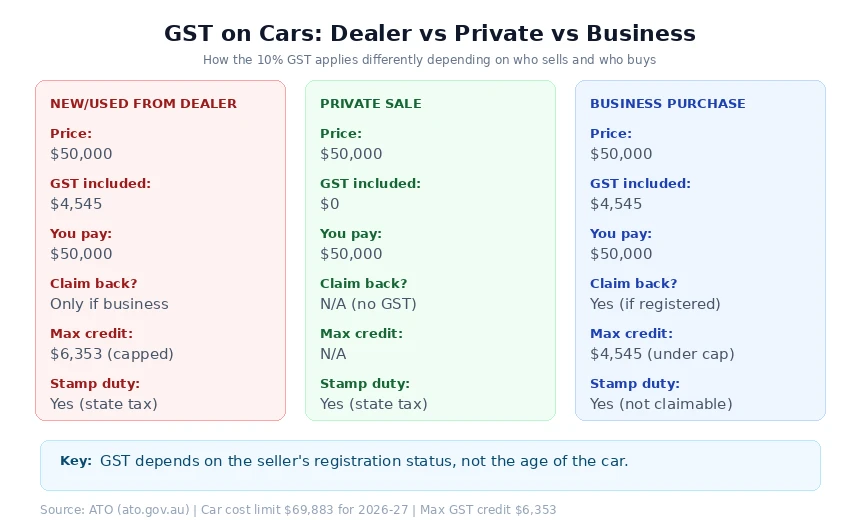
A new car from a dealer includes 10% GST in the drive-away price. A used car from a dealer also includes GST. But buy that same car privately and there’s no GST at all. The seller’s GST registration status is what determines the tax, not the age of the vehicle.
That one rule creates a price gap between dealer and private sales that catches buyers off guard. And if you’re buying for business, there’s a cap on how much GST you can claim back. Here’s how all of it works.
Quick answer
GST at 10% is included in the price of any car sold by a GST-registered dealer (new or used). Private sales between individuals have no GST. If you’re buying for a GST-registered business, you can claim the GST back, but the credit is capped at $6,353 for 2026-27 (one-eleventh of the $69,883 car cost limit). Use our GST calculator to find the exact GST on any car price.
When Does GST Apply to a Car?
It depends entirely on who’s selling it.
Dealer sale (new or used)
GST-registered dealer sells you a car.
You pay 10% GST included in the advertised price. This is the law under Australian Consumer Law: the displayed price must be the total you pay.
Private sale
A private individual sells you a car.
No GST. Private sellers aren’t GST-registered businesses, so they can’t charge GST. The price is what you agree on.
Unregistered small business
Seller’s turnover is under $75,000 and they haven’t voluntarily registered.
No GST. Same as a private sale. No registration means no GST obligation.
So the same $40,000 used car costs $40,000 from a private seller but includes $3,636 of GST when sold by a dealer. That’s the gap dealers complain about, and it’s why private sales can look cheaper on paper. But dealers offer statutory warranties, financing and consumer protection that private sellers don’t.
How Much GST on a Car? Worked Examples
The GST on any car price is simply the total divided by 11. That gives you the GST component. Here are three common price points:
| Car price (inc GST) | GST included | Price before GST |
|---|---|---|
| $30,000 | $2,727 | $27,273 |
| $50,000 | $4,545 | $45,455 |
| $80,000 | $7,273 | $72,727 |
For any other amount, use our GST calculator or divide by 11. Our guide on the divide-by-11 method explains why this formula works.
GST on New Cars
Every new car sold by a dealer in Australia includes 10% GST. No exceptions. The manufacturer charges GST when selling to the dealer, and the dealer charges GST when selling to you. The GST is built into the advertised price under Australian Consumer Law, so the number on the sticker is what you pay.
A new car at a drive-away price of $55,000 includes $5,000 of GST ($55,000 / 11). You don’t see it as a separate line on the price tag, but it’s there. It shows up on the tax invoice the dealer gives you after purchase.
GST on Used Cars
Used cars follow the same rule as new ones: if the seller is GST-registered (and any licensed car dealer will be), the sale price includes 10% GST.
This is the part that confuses people. The first owner already paid GST when the car was new. Now the dealer is charging GST again on the used sale price. But GST isn’t a one-time tax on the car. It’s a tax on each taxable sale. Every time a GST-registered business sells the car, GST applies to that sale.
The dealer can claim a GST credit when they buy the car (either from trade-in or at auction), and then they charge GST when they sell it to you. The GST the dealer remits to the ATO is effectively on their margin, not the full value of the car again.
GST on Private Car Sales
No GST. Private sellers aren’t registered for GST, so they can’t charge it. If you buy a $25,000 car from someone’s driveway, you pay $25,000. No GST component.
This is why private sales often look cheaper than dealer prices for similar cars. The dealer has to add 10% GST to their selling price. The private seller doesn’t. But keep in mind: private sales come with no statutory warranty, no cooling-off period, and limited consumer protection. The price difference partly reflects that.
Stamp duty still applies to private sales in every state and territory. That’s a state tax, not GST, and you’ll pay it when you transfer the registration.
Buying a Car for Business: GST Credits and the Car Cost Limit
If you run a GST-registered business and buy a car for business use, you can claim the GST back as an input tax credit on your BAS. But there’s a cap.
The ATO sets a car cost limit each financial year. For 2026-27, the car cost limit is $69,883. The maximum GST credit you can claim on any car purchase is one-eleventh of that limit: $6,353.
Even if the car costs $90,000 and includes $8,182 of GST, your credit is capped at $6,353. You can’t claim GST on the luxury car tax component either.
Worked example: business car purchase
Sarah buys a new car for $66,000 (including $6,000 GST) and uses it 80% for her GST-registered business. The car is under the $69,883 limit, so the full GST amount is available. Her credit is $6,000 x 80% = $4,800. She reports this at Label 1B on her BAS.
Worked example: car above the limit
James buys a car for $91,243 (including $8,076 GST and $2,408 LCT) and uses it 100% for business. The car exceeds the $69,883 limit, so his maximum GST credit is capped at $6,353. He can’t claim a credit for the luxury car tax. This is the ATO’s own worked example from their motor vehicle GST guidance.
If the car is used partly for business and partly for private driving, you can only claim the business portion. Keep a logbook for at least 12 weeks to establish your business-use percentage.
What About Luxury Car Tax?
Luxury car tax (LCT) is a separate tax on top of GST. It kicks in when a car’s GST-inclusive value exceeds the LCT threshold. For 2026-27:
Other vehicles
$80,809
Fuel-efficient vehicles
$91,661
LCT rate
33%
On the amount above the threshold
A fuel-efficient car must have a combined fuel consumption of 3.5 litres per 100km or less (from 1 July 2025, down from 7L/100km previously). Most electric vehicles qualify for the higher threshold. Many hybrids that used to qualify no longer do under the tighter definition.
You can’t claim a GST credit for the LCT you pay, even if the car is 100% for business. LCT is always an absorbed cost.
Stamp Duty vs GST: They’re Separate
Stamp duty (or motor vehicle duty) is a state government tax charged when you transfer vehicle registration. It applies to every car purchase, dealer and private. GST is a federal tax charged only on sales by GST-registered businesses.
You’ll pay both on a dealer purchase. You’ll pay only stamp duty on a private purchase. The rates and thresholds vary by state and territory, and some states offer concessions for EVs or low-emission vehicles. Stamp duty is not claimable as a GST credit.
Selling Your Car: When GST Applies
If you’re a private individual selling your personal car, no GST. You’re not a business.
If you’re a GST-registered business selling a vehicle you used in the business, GST applies. You charge 10% GST on the sale price and report it on your BAS. This is true even if you originally bought the car before GST was introduced in July 2000.
And if you trade in a business vehicle to a dealer, the trade-in value is treated as a GST-inclusive sale from you to the dealer. You include the GST component in your BAS reporting.
Frequently Asked Questions
How much GST is on a $30,000 car?
The GST on a $30,000 car (bought from a dealer) is $2,727. That’s $30,000 divided by 11. The price before GST is $27,273. Use our GST calculator to check any amount.
Is there GST on a used car from a dealer?
Yes. Any car sold by a GST-registered dealer includes 10% GST, whether it’s new or used. The GST is built into the advertised price.
Is there GST on a private car sale?
No. Private sellers aren’t registered for GST, so they can’t charge it. You’ll still pay stamp duty when you transfer the registration, but no GST.
Can I claim GST on a car bought for my business?
If you’re GST-registered and the car is for business use, yes. But the credit is capped at $6,353 for 2026-27 (one-eleventh of the $69,883 car cost limit). If you use the car partly for private driving, you can only claim the business-use portion. Keep a logbook to support your claim.
What is the car cost limit for GST in 2026-27?
The car cost limit for 2026-27 is $69,883. This caps the GST credit you can claim at $6,353 (one-eleventh of $69,883). Even if your car costs more, the credit doesn’t go above this amount unless you fall into one of the ATO’s exceptions (trading stock, emergency vehicles, or commercial vehicles not principally designed for passengers).
When does luxury car tax apply?
Luxury car tax applies when a car’s GST-inclusive value exceeds $80,809 (other vehicles) or $91,661 (fuel-efficient vehicles) in 2026-27. The tax is 33% on the amount above the threshold. You can’t claim a GST credit for LCT, even if the car is for business.
Do I pay GST on a car lease?
Yes. Each lease payment includes GST. If you’re GST-registered and the car is for business, you can claim a GST credit on each payment based on your business-use percentage. The car cost limit does not cap GST credits on lease payments.
Is stamp duty the same as GST on a car?
No. Stamp duty is a state government tax on vehicle registration transfers. GST is a federal tax on sales by GST-registered businesses. You pay both on a dealer purchase and only stamp duty on a private purchase. Stamp duty rates vary by state and territory.
Disclaimer: This guide is general information only, current as at September 2026. It is not financial, tax or legal advice. Car cost limits, LCT thresholds and stamp duty rates change annually. Consult a registered tax agent or contact the ATO directly for advice about your specific situation.