GST on Property in Australia: Residential, Commercial and New Builds
Buying an existing house to live in? No GST. Buying a brand-new apartment off the plan? 10% GST is baked into the price. And commercial property? Always taxable, whether it’s a sale or a lease.
Those three rules cover most situations. But property GST gets complicated fast once you bring in the margin scheme, going concern exemptions and GST withholding at settlement. Here’s how it all works.
Quick answer
Existing residential property is input-taxed (no GST). New residential premises and commercial property are taxable at 10% GST. The margin scheme lets developers pay GST on the profit margin only. Buyers of new residential property and potential residential land must withhold the GST and pay it directly to the ATO at settlement. Use our GST calculator to find the GST on any property price.
Existing Residential Property: No GST
The sale of an existing home is input-taxed. That means no GST for the buyer and no GST credits for the seller. It doesn’t matter whether the seller is an individual, a company or a trust. If the property is existing residential premises, the sale is input-taxed.
Rental income from residential property is also input-taxed. So landlords don’t charge GST on rent or bonds, and they can’t claim GST credits on expenses like repairs, property management fees or insurance premiums related to the rental.
This is the rule most Australians are familiar with. You buy a house, you pay the price. No GST on top. Stamp duty still applies (that’s a state tax, separate from GST), but the federal GST system treats existing residential property as input-taxed.
New Residential Premises: GST Applies
This is where it changes. New residential premises are taxable supplies. The developer or builder charges 10% GST on the sale price, and they can claim GST credits on construction costs.
The ATO defines “new residential premises” in three ways:
Never previously sold
The property has never been sold as residential premises before. This covers off-the-plan apartments, newly built houses, and display homes sold for the first time.
Substantially renovated
A renovation so extensive that it creates essentially a new building. A kitchen and bathroom refresh doesn’t count. The ATO looks at whether all or substantially all of the building has been removed or replaced.
Built to replace a demolished building
New construction on land where the previous building was demolished. Knock down an old house and build a new one? The new build is new residential premises.
The five-year rule
New residential premises don’t stay “new” forever. If a property has been continuously rented out for five years or more, it’s no longer treated as new for GST purposes (unless it was actively marketed for sale during the rental period). After five years of continuous rental, a sale becomes input-taxed, just like any other existing residential property.
This matters for developers who build apartments, rent them out, and then sell later. Hold it past five years and the GST treatment flips.
Worked example: new apartment sale
A developer sells a brand-new apartment for $660,000 including GST. The GST component is $660,000 / 11 = $60,000. The buyer’s solicitor withholds that $60,000 and pays it directly to the ATO at settlement. The developer receives $600,000.
Commercial Property: Always Taxable
Commercial property sales and leases are taxable supplies. That means 10% GST applies whether you’re selling an office building, leasing a retail shop, or subletting a warehouse.
The seller charges GST on the sale price. If both parties are GST-registered and the buyer is using the property for a creditable business purpose, the buyer can claim the GST back as an input tax credit. Commercial tenants also pay GST on their rent and can claim credits on those lease payments.
Commercial residential premises (hotels, motels, serviced apartments, boarding houses, caravan parks) are also always taxable. Even though they provide accommodation, they’re treated as commercial, not residential, for GST purposes.
Worked example: commercial lease
A business rents office space at $5,500 per month (GST-inclusive). The monthly GST is $5,500 / 11 = $500. The tenant (if GST-registered and using the office for business) claims $500 each month as an input tax credit on their BAS.
Going Concern: When Property Sales Are GST-Free
A property sold as a going concern is GST-free. This usually applies to commercial properties sold with an existing tenant and lease in place. The buyer steps into the seller’s shoes and continues operating the business or investment as it was.
The ATO requires three conditions for a going concern to be GST-free:
The sale is for payment (not a gift).
The buyer is registered (or required to be registered) for GST.
Both parties have agreed in writing that the sale is of a going concern.
On top of those three conditions, the seller must supply everything necessary for the enterprise to continue, and the enterprise must be carried on up until the day of settlement. A commercial building with a vacant lease doesn’t qualify. Neither does a property where the tenant left two months before settlement.
Get this wrong and the sale is taxable. The seller owes 10% GST to the ATO, and if the contract doesn’t account for that, it comes out of their pocket. Always get legal and tax advice before relying on the going concern exemption.
Worked example: going concern
Mark sells a commercial warehouse for $1,200,000. The warehouse has a tenant on a five-year lease. Both Mark and the buyer are GST-registered, and their contract states the sale is of a going concern. Mark continues operating until settlement. The sale is GST-free. The buyer pays $1,200,000 with no GST component and no withholding.
The Margin Scheme
Normally, GST is calculated on the full sale price: one-eleventh of a $660,000 sale is $60,000 in GST. The margin scheme changes this. Instead of paying GST on the full price, the seller pays GST only on the margin (the difference between what they paid for the property and what they sold it for).
The margin scheme is optional. Both seller and buyer must agree in writing before settlement. It’s available for taxable property sales (new residential and commercial), but not for going concern sales (they’re already GST-free).
You can use our margin scheme calculator to work out the GST under both the standard method and the margin scheme.
Worked example: margin scheme vs standard
A developer bought land for $400,000 and sells the completed townhouse for $880,000.
Standard method: GST = $880,000 / 11 = $80,000
Margin scheme: Margin = $880,000 – $400,000 = $480,000. GST = $480,000 / 11 = $43,636
The margin scheme saves $36,364 in GST. But the developer can’t claim GST credits on construction costs when using the margin scheme. The right choice depends on the numbers. Try both options in our margin scheme calculator.
GST Withholding at Settlement
Since 1 July 2018, buyers of new residential premises and potential residential land must withhold the GST at settlement and pay it directly to the ATO. The seller doesn’t get the GST portion. It goes straight to the tax office.
This was introduced to stop developers collecting the GST from the buyer, then folding the company before remitting it to the ATO (a practice called phoenix activity).
Standard method
1/11 of the price
Withheld and paid to the ATO
Margin scheme
7% of the price
Withheld and paid to the ATO
The buyer’s solicitor or conveyancer handles this. They lodge Form 1 (withholding notification) and Form 2 (settlement date) with the ATO. At settlement, the withheld amount goes to the ATO and the balance goes to the seller.
If you’re buying an existing residential property (not new), there’s no GST withholding. This only applies to new residential premises and potential residential land (vacant blocks zoned or intended for residential development).
Vacant Land
Vacant land can be taxable or GST-free depending on who’s selling and why.
If a GST-registered developer or business sells a vacant block that’s part of a residential subdivision or a commercial venture, GST applies. Potential residential land (vacant blocks zoned for housing) also triggers the GST withholding rules for the buyer.
If a private individual sells a vacant block they’ve been sitting on and they’re not in the business of developing or selling land, no GST applies. They’re not carrying on an enterprise.
The grey area is hobby farmers, lifestyle block owners and people who subdivide their backyard. If the ATO considers the subdivision an enterprise (regular activity carried on for profit), GST can apply even if you don’t think of yourself as a developer. Get advice before you settle.
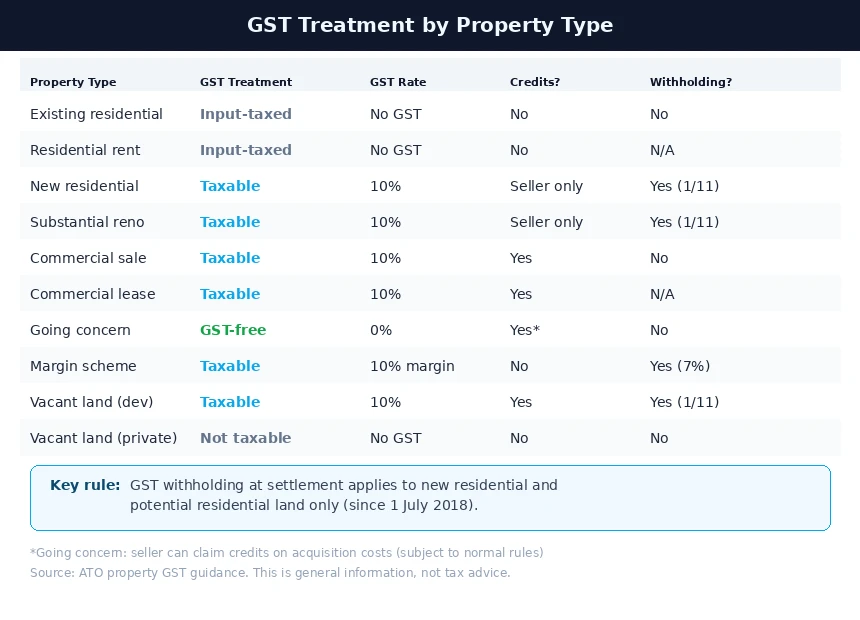
Summary: GST by Property Type
| Property type | GST treatment | Withholding? |
|---|---|---|
| Existing residential | Input-taxed (no GST) | No |
| New residential | Taxable (10%) | Yes |
| Commercial (sale or lease) | Taxable (10%) | No |
| Going concern | GST-free | No |
| Potential residential land | Taxable (10%) | Yes |
| Commercial residential (hotels etc.) | Taxable (10%) | No |
Frequently Asked Questions
Do I pay GST when buying a house in Australia?
If you’re buying an existing house, no. Existing residential property is input-taxed, so no GST is included in the price. If you’re buying a newly built house that has never been sold before, GST at 10% is included in the purchase price and the buyer’s solicitor withholds the GST portion at settlement.
How much GST is on a new apartment?
The GST on any property price is the total divided by 11. A $550,000 apartment includes $50,000 of GST and a base price of $500,000. Use our GST calculator or the divide-by-11 method to check any amount.
Is GST charged on commercial rent in Australia?
Yes. Commercial leases are taxable supplies. The landlord charges 10% GST on the rent, and GST-registered tenants can claim the GST as an input tax credit. Residential rent is input-taxed, so no GST applies to residential leases.
What is the margin scheme for property GST?
The margin scheme lets sellers pay GST on the profit margin only (sale price minus original purchase price), rather than on the full sale price. Both parties must agree in writing before settlement. It’s available for taxable property sales but the seller gives up the right to claim GST credits on construction costs. Use our margin scheme calculator to compare both methods.
What does “going concern” mean for property GST?
A going concern sale is GST-free. It applies when a commercial property is sold with its business or tenancy intact. The ATO requires: the sale is for payment, the buyer is GST-registered, both parties agree in writing, the seller supplies everything necessary for the enterprise to continue, and the enterprise operates right up until settlement.
What is GST withholding at settlement?
Since 1 July 2018, buyers of new residential premises and potential residential land must withhold the GST from the contract price and pay it directly to the ATO at settlement. The amount is 1/11 of the price (standard method) or 7% of the price (margin scheme). This prevents sellers from collecting GST and then not remitting it.
Is GST charged on vacant land?
It depends on the seller. If a GST-registered developer or business sells vacant land as part of a subdivision or commercial venture, GST applies. If a private individual sells a block they’ve been holding and they’re not carrying on an enterprise, no GST. Subdivisions can trigger enterprise status even for individuals, so get advice before settling.
Can I claim GST credits on a commercial property purchase?
If you’re GST-registered and the property is for a creditable business purpose, yes. The GST on a commercial purchase is claimable as an input tax credit. See our input tax credit guide for the eligibility conditions. You can’t claim credits on residential property purchases because residential sales are either input-taxed or, for new builds, the GST goes to the ATO via withholding.
Disclaimer: This guide is general information only, current as at September 2026. It is not financial, tax or legal advice. Property GST rules are complex and depend on the specific transaction. Always consult a registered tax agent, accountant or property lawyer before relying on the GST treatment described here. Contact the ATO directly for advice about your specific situation.