
Australian Tax Essentials
What is GST in Australia? Rate, Rules & Who Pays
Goods and Services Tax (GST) is a broad-based tax of 10% on most goods, services, and other items sold or consumed in Australia. It was introduced on 1 July 2000 under the Howard government as part of a major overhaul of Australia’s tax system, replacing a patchwork of federal and state taxes.
GST is administered by the Australian Taxation Office (ATO) and is collected at every stage of the supply chain — from manufacturer to wholesaler to retailer. Consumers pay the final GST amount, and businesses along the chain claim back the GST they’ve already paid through input tax credits.
The GST rate in Australia is 10% and has never changed since introduction. Unlike India (which has four slabs from 5% to 28%) or the UK (with standard, reduced, and zero rates), Australia keeps it simple — one rate for everything that’s taxable.
How It Works
How GST Works — The Supply Chain
GST is a multi-stage tax, but it doesn’t snowball. Each business in the chain only pays GST on the value it adds — not on the full price.
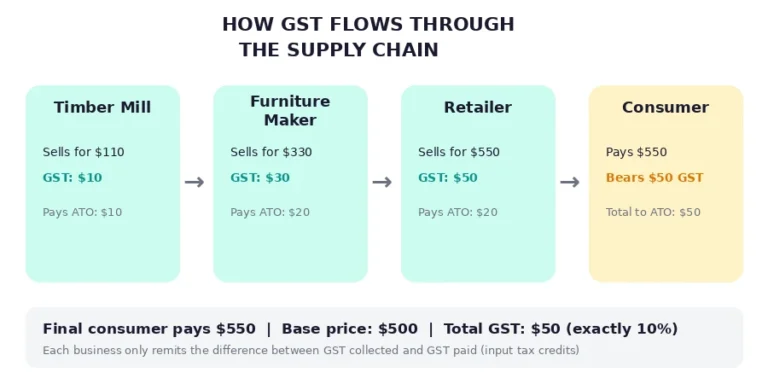
Here’s a simplified example of a product moving from manufacturer to consumer:
|
Stage |
Sale Price (ex GST) |
GST Charged |
GST Credits |
Net GST to ATO |
|---|---|---|---|---|
|
Manufacturer → Wholesaler |
$100 |
$10 |
$0 |
$10 |
|
Wholesaler → Retailer |
$150 |
$15 |
$10 |
$5 |
|
Retailer → Consumer |
$200 |
$20 |
$15 |
$5 |
|
Total GST collected by ATO |
$20 |
The consumer pays $220 ($200 + $20 GST). The ATO receives $20 in total — collected in three instalments from three businesses. No business bears the cost; they pass it through.
Does GST come out of a business owner’s pocket?
No. GST is a pass-through tax. You collect it from your customers and remit it to the ATO. You also claim back GST you pay on business purchases. The consumer bears the final cost.
Supply Types
Taxable, GST-Free, and Input-Taxed — The Three Types of Supply
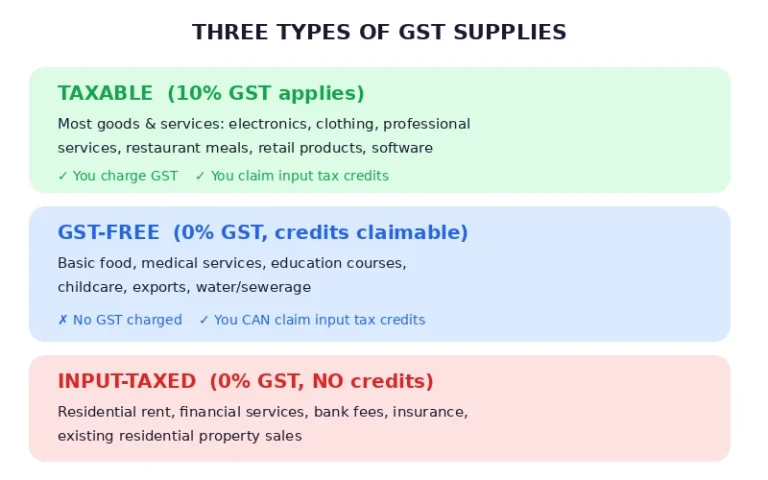
Not everything in Australia attracts GST. The GST Act classifies all sales into three categories:
Taxable supplies
GST of 10% applies. Most goods and services fall here. Examples: electronics, clothing, professional services, restaurant meals, software subscriptions.
GST-free supplies
No GST is charged, but the business can still claim input tax credits on related purchases. Examples: most basic foods, medical services, education courses, exports, childcare.
Input-taxed supplies
No GST is charged, and the business cannot claim input tax credits. Examples: residential rent, financial services (bank fees, insurance premiums), sale of existing residential property.
The critical difference between GST-free and input-taxed is credits. A business making GST-free supplies gets its input credits back. A business making input-taxed supplies absorbs the GST on its costs.
For a full guide on what you can claim and how to report it on your BAS, see our guide to input tax credits.
What does “GST-free” mean?
A GST-free supply is a sale where no GST is charged to the customer, but the business can still claim input tax credits on its related purchases. It’s different from “input-taxed,” where those credits are denied.
Registration
Who Must Register for GST?
Registration is mandatory if your business meets any of these conditions:
Annual turnover of $75,000 or more — this is gross income, not profit. Once you reach this threshold (or reasonably expect to), you have 21 days to register.
Non-profit organisations with $150,000+ turnover — a higher threshold recognising their community role.
Taxi and rideshare drivers — Uber, Ola, DiDi, and any similar platform. Must register from dollar one, regardless of turnover.
Registration requires an Australian Business Number (ABN). You can register online through the ATO’s Business Registration Service.
Voluntary registration is also an option. If your turnover is below $75,000 but you have significant GST-inclusive business expenses (equipment, vehicles, supplies), registering lets you claim those credits back. The trade-off: you must charge GST on your sales and lodge BAS returns.
For a full breakdown of when to use inclusive vs exclusive pricing and what Australian law requires, see our guide to GST-inclusive vs GST-exclusive pricing.
Do I have to register for GST under $75,000?
No. Registration is optional below $75,000. But voluntary registration lets you claim GST credits on business purchases. You must stay registered for at least 12 months.
History
When Did GST Start in Australia?
GST commenced on 1 July 2000 as part of “A New Tax System” introduced by the Howard government. It replaced the Wholesale Sales Tax (WST) and a range of state taxes.
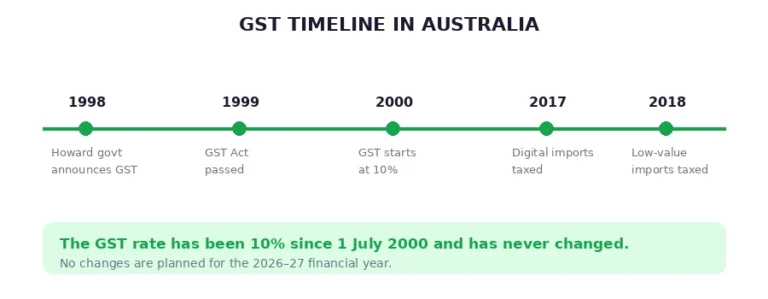
1998 — Treasurer Peter Costello announces the GST proposal alongside income tax cuts and the abolition of WST.
1999 — The A New Tax System (Goods and Services Tax) Act 1999 passes parliament after negotiations with the Australian Democrats. Fresh food is excluded from GST as part of the deal.
1 July 2000 — GST takes effect. The rate is set at 10%.
2000–2026 — The rate has never changed. Multiple governments have considered increasing it, but no change has been legislated.
1 July 2018 — GST extended to low-value imported goods (under $1,000), closing the “Netflix tax” loophole where overseas digital services and cheap imports avoided GST.
Exemptions
What Items Are GST-Free?
Basic food
Fresh fruit, vegetables, meat, bread, milk, eggs, cooking ingredients. But not prepared meals, restaurant food, takeaway, confectionery, snack foods, or soft drinks.
Health and medical
Services by registered practitioners (doctors, dentists, optometrists, physiotherapists), prescription medicines on the PBS, hospital treatment, ambulance services.
Education
Accredited primary, secondary, and tertiary courses, including course materials supplied by the provider.
Childcare
Approved long day care, family day care, and outside school hours care.
Exports
Goods exported within 60 days of sale.
Water and sewerage
Government/council-provided water and sewerage services.
For the complete breakdown with edge cases and examples, see our full GST-free items list.
Is food GST-free in Australia?
Most basic, unprocessed food is GST-free — fresh fruit, vegetables, meat, bread, milk, eggs, and cooking ingredients. But prepared meals, restaurant food, takeaway, confectionery, snack foods, soft drinks, and alcohol are NOT GST-free. Context matters too — a bread roll from a bakery is GST-free, but the same roll served at a restaurant attracts GST.
International Comparison
Is GST the Same as VAT?
Essentially, yes. GST and VAT (Value Added Tax) are the same type of tax — a consumption tax collected at each stage of the supply chain. The mechanism is identical. Only the name and the rate differ.
|
Country |
Tax Name |
Rate |
|---|---|---|
|
Australia |
GST |
10% |
|
New Zealand |
GST |
15% |
|
Singapore |
GST |
9% |
|
United Kingdom |
VAT |
20% |
|
Canada |
GST (federal) |
5% |
|
India |
GST |
5%–28% (4 slabs) |
|
EU average |
VAT |
~21% |
Australia’s 10% sits well below the global average for consumption taxes. The simplicity of a single rate (compared to India’s four-slab system or the EU’s multiple rates) makes compliance relatively straightforward.
Thresholds
The $75,000 GST Threshold — What Counts as Turnover?
“Turnover” for GST purposes means your gross business income — not profit. Revenue before expenses. This catches many new business owners off guard.
For example, if your business earns $80,000 in revenue but has $60,000 in expenses, your profit is $20,000 — but your GST turnover is $80,000. You must register.
The ATO uses two tests:
Current turnover — your actual turnover for the past 12 months. If it’s hit $75,000, register within 21 days.
Projected turnover — your likely turnover for the next 12 months. If you reasonably expect to reach $75,000, register now. The ATO gives the example of “Barry,” a sole trader who monitors his monthly income and projects forward.
GST turnover includes all sales connected with your business — cash, credit, barter, and in-kind. It excludes input-taxed sales and sales not connected with your business.
I just hit $75,000 — do I owe GST on everything I’ve already earned?
No. GST applies from your registration date forward. But if you should have registered earlier and didn’t, the ATO can require you to pay 1/11th of all sales since the date you were required to register, plus penalties and interest.
Frequently Asked Questions