GST-Inclusive vs GST-Exclusive Pricing — What Australian Law Requires
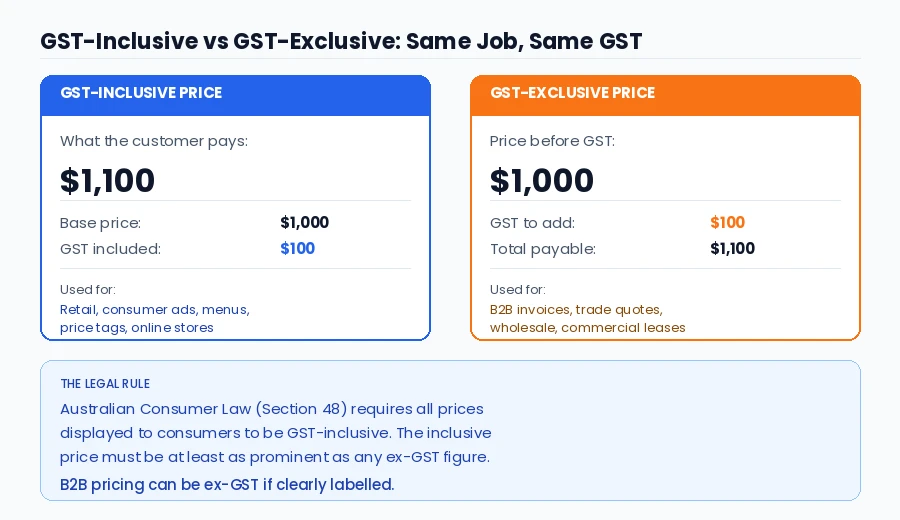
A GST-inclusive price is the total amount a customer pays, with the 10% GST already baked in. A GST-exclusive price is the base amount before GST gets added. The dollar figure changes, but the GST itself is identical. A $1,000 ex-GST job and a $1,100 inc-GST job are the same job — the only difference is how the number is presented.
Where it gets serious is the law. Australian Consumer Law requires every price shown to consumers to be GST-inclusive. No exceptions. Advertising “$100 + GST” to a retail customer is a breach of Section 48 of the ACL. The ACCC has fined businesses for this — Air Asia copped $200,000 for showing prices without taxes and charges included.
Our complete guide to calculating GST covers the formulas for converting between inclusive and exclusive prices. This post covers the rules around when you use each format, what the law says, and how to get your invoices and quotes right.
THE SHORT VERSION
GST-inclusive = total price with GST inside. Customer pays this number.
GST-exclusive = base price before GST. Add 10% to get the total.
Selling to consumers? You must show the inclusive price. It’s the law.
Selling to businesses? You can quote ex-GST if it’s clearly labelled.
What GST-Inclusive and GST-Exclusive Actually Mean
GST-inclusive means the price already contains the 10% Goods and Services Tax. When a café menu says a flat white costs $5.50, that’s inclusive — the customer pays $5.50 and nothing more. Inside that $5.50, the GST component is $0.50 (calculated by dividing by 11), and the café’s actual revenue is $5.00.
GST-exclusive means the price doesn’t include GST yet. A trade supplier quoting “$500 + GST” for a pallet of timber is telling you the base price is $500. The actual bill will be $550 once the 10% GST is added on top. The supplier’s quote is $500 ex-GST, but you’ll pay $550 inc-GST.
Both formats describe the same transaction. The base price, the GST amount, and the total are all identical — it’s just a question of which number gets the spotlight.
The Legal Rule: Consumers Must See the Inclusive Price
Section 48 of the Australian Consumer Law is clear: any price displayed, advertised, or quoted to a consumer must be a single price that includes GST and all other mandatory charges. The GST-inclusive price must be at least as prominent as any ex-GST amount shown alongside it.
This applies everywhere a consumer might see a price — shopfronts, websites, social media ads, flyers, email promotions, menus, price tags, and online checkout pages. If you’re selling to the general public, the number they see is the number they pay. No surprises at the register.
CORRECT (consumer pricing)
“Flat white — $5.50”
“Oil change — $150”
“Lawn mowing from $80”
WRONG (consumer pricing)
“Flat white — $5.00 + GST”
“Oil change — $136.36 + GST”
“Lawn mowing from $72.73 + GST”
The ACCC enforces this actively. Drip pricing — showing a low headline price and then adding GST, service fees, or “admin charges” at checkout — is a breach of the ACL. Airlines, ticket sellers, and online retailers have all been fined for this practice.
When You Can Use Ex-GST Pricing
Business-to-business (B2B) transactions play by different rules. When both parties are GST-registered businesses, it’s standard practice to quote prices exclusive of GST. Trade suppliers, wholesalers, and professional services firms do this routinely.
The reason is practical: GST-registered businesses claim the GST back on their BAS, so the GST component is a pass-through cost, not an actual expense. A builder buying $10,000 worth of materials ex-GST pays $11,000 at the counter but claims the $1,000 GST back from the ATO. Their real cost is $10,000 — the ex-GST figure.
Quoting ex-GST in B2B makes pricing cleaner. But there are conditions. The quote, invoice, or price list must clearly state that prices are exclusive of GST. Phrases like “all prices ex-GST,” “plus GST,” or “GST not included” must be visible. If those words aren’t there, the law expects the price to be inclusive.
THE GREY AREA
Some businesses serve both consumers and other businesses — a hardware store, a printing shop, a cleaning service. If any of your advertising reaches consumers, the prices in that advertising must be inclusive. You can quote ex-GST on direct B2B invoices, but the moment the price appears on a public-facing website, social media post, or printed flyer, it’s consumer pricing and must include GST.
How to Convert Between Inclusive and Exclusive
Two formulas cover every conversion. Use our GST calculator if you want instant results, or do it manually:
+
Ex-GST to Inclusive
Multiply by 1.1
$500 x 1.1 = $550 inc GST
–
Inclusive to Ex-GST
Divide by 1.1
$550 / 1.1 = $500 ex GST
=
Find the GST Amount
Divide inclusive price by 11
$550 / 11 = $50 GST
For a deeper explanation of why the third formula uses 11, see our guide to why you divide by 11 for GST.
Getting Your Tax Invoices Right
Every tax invoice from a GST-registered business must show the GST component. You’ve got two options: show the GST as a separate line item (subtotal + GST + total), or state that the total price includes GST. Both are valid under ATO rules.
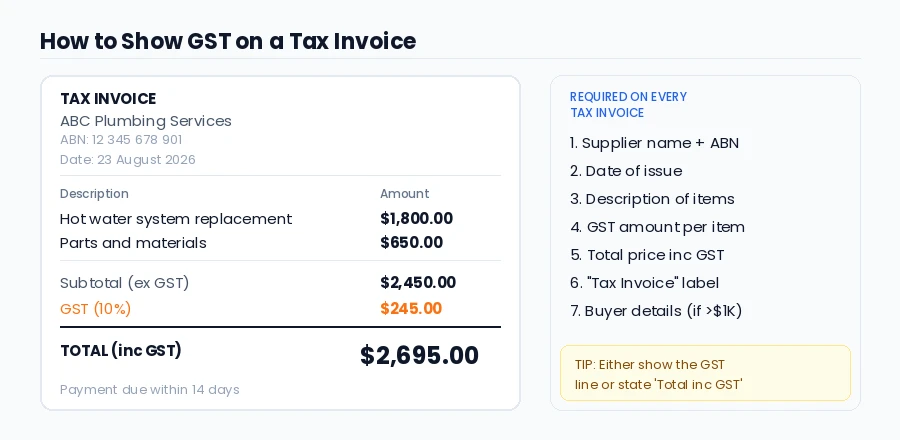
The ATO requires seven elements on every tax invoice: your business name and ABN, the date, a description of what was sold, the GST amount or a statement that the total includes GST, the total price, the words “Tax Invoice,” and for invoices over $1,000, the buyer’s name or ABN. Missing any of these means your customer can’t claim their GST credit — and that creates problems for both of you.
If you issue invoices ex-GST (common for B2B), always include a separate GST line and the inclusive total. Something like: Subtotal $2,450.00 / GST $245.00 / Total (inc GST) $2,695.00. That format gives the buyer everything they need for their BAS return and keeps the ATO happy.
Common Pricing Mistakes
1. Advertising ex-GST prices to consumers
A tradie posting “deck builds from $5,000 + GST” on Facebook is advertising to consumers. That’s a breach of the ACL. The ad should say “deck builds from $5,500.” Even if most of your clients are other businesses, public-facing ads must show inclusive prices.
2. Forgetting you’re GST-registered
Some sole traders register for GST but keep quoting the same prices they charged before registration. If you were charging $100 and you’re now GST-registered, that $100 is now GST-inclusive — meaning $9.09 of every $100 goes to the ATO. If you want to keep earning $100 per job, your new price needs to be $110. Check your registration status on our GST registration guide.
3. Mixing inclusive and exclusive on the same page
A website showing some products at inc-GST prices and others at ex-GST prices is confusing and potentially misleading. Pick one format and stick to it across your entire site. If you show an ex-GST figure alongside the inclusive price, the inclusive number must be at least as prominent.
4. Not specifying which format you’re using
A quote that says “$3,000” with no mention of GST leaves the client guessing. Is that inclusive or exclusive? Always state it. Add “inc GST” or “plus GST” after every price. Ambiguity leads to disputes when the invoice arrives 10% higher than the client expected.
5. Charging GST when you’re not registered
If you’re under the $75,000 threshold and haven’t registered, you can’t add a GST line to your invoices. Your invoices should say “Invoice” (not “Tax Invoice”) and should not show a GST component. Charging GST when you’re not registered to collect it is a compliance issue the ATO takes seriously. See our sole trader GST registration guide for threshold details.
Industry-Specific Pricing Norms
What About GST-Free Items?
Some goods and services don’t attract GST at all. Basic food (fresh fruit, bread, milk, raw meat), health services, education, and exports are all GST-free under Australian law. For these items, inclusive and exclusive prices are the same number — there’s no GST to add or remove.
If you sell a mix of taxable and GST-free items (like a supermarket or a health food shop), your receipts will show the GST calculated only on the taxable portion. You can’t just divide the receipt total by 11 to find the GST — the mixed nature of the items means the printed GST line on the receipt is the accurate figure. Our guide to GST on food breaks down exactly which food items are taxed and which aren’t.
For a real-world example, see how GST-inclusive pricing works when buying a car from a dealer vs a private seller.
Frequently Asked Questions
What does “all prices are exclusive of GST” mean?
It means every price listed is the base amount before GST. Add 10% to each price to get the total you’ll actually pay. A price list showing “$200 ex-GST” means you’ll pay $220. This phrasing is common in B2B contexts where both parties are GST-registered.
Can I show both inclusive and exclusive prices?
Yes, and many B2B invoices do exactly that — showing the ex-GST subtotal, the GST line, and the inclusive total. But if any of this is consumer-facing, the inclusive price must be at least as prominent as the exclusive figure. You can’t show “$100 + GST” in large text and “$110 inc GST” in tiny print underneath.
Do I need to show GST-inclusive prices on my website?
If your website sells to consumers (anyone who isn’t a GST-registered business buying for business purposes), yes. Australian Consumer Law applies to websites the same way it applies to physical shops. Every price a consumer sees must be the total, inclusive amount.
What happens if I advertise ex-GST prices to consumers?
The ACCC can take enforcement action. Penalties range from infringement notices to court-imposed fines. Air Asia was fined $200,000 for displaying airfares without taxes included. The risk isn’t theoretical — the ACCC actively monitors pricing practices.
How do I know if a price is inclusive or exclusive?
Look for the words “plus GST,” “ex-GST,” “GST exclusive,” or “excl. GST” near the figure. If none of those markers appear, the law expects the price to be inclusive. When in doubt, ask the seller to confirm before committing.
Is residential rent GST-inclusive or exclusive?
Residential rent is GST-free — no GST applies at all. The question of inclusive vs exclusive doesn’t arise because there’s no GST component either way. Commercial rent, on the other hand, typically has GST. Commercial leases usually specify the rent as exclusive of GST, with the tenant paying rent plus 10% GST on top.
What’s the difference between “inc GST” and “plus GST”?
“Inc GST” means the price already includes the tax — that’s the total you pay. “Plus GST” means the tax hasn’t been added yet — expect 10% more on top. They’re opposite phrases. $100 inc GST means you pay $100. $100 plus GST means you pay $110.
Do prices on Gumtree or Facebook Marketplace need to include GST?
If you’re a GST-registered business selling through those platforms, yes — the prices consumers see must be inclusive. If you’re a private individual selling personal items, GST doesn’t apply to you at all, so the question doesn’t arise. The rule follows the seller’s GST status, not the platform.