GST for Uber and Rideshare Drivers in Australia
If you drive for Uber, DiDi, Ola or any other rideshare app, you must register for GST before your very first paid trip, even if you only drive a few hours a week.
That’s different from almost everyone else in business: most sole traders don’t touch GST until they turn over $75,000 a year, so it catches plenty of new drivers out. This guide covers when and how to register, how much GST you owe on your fares, which GST credits you can claim on your car and the platform’s fees, and how to fill in your BAS. Use the Uber GST calculator above to work out your quarter.
Quick answer
- Register before your first trip. The $75,000 threshold doesn’t apply to rideshare.
- Your fares already include GST. The GST is 1/11 of the gross fare.
- Claim GST credits on the platform’s service fee and the business share of your car costs.
- Lodge quarterly or monthly. Annual GST reporting isn’t available to rideshare drivers.
Do Uber drivers have to register for GST?
Yes, every one of them. Under the GST law, anyone supplying taxi travel must be registered no matter how much they earn, and the ATO has treated ride-sourcing as taxi travel since 1 August 2017. So whether you drive Uber full time or do a couple of Friday nights a month, the rule is the same.
The timing matters too. The ATO says you need to be registered before your first trip. If you already had an ABN for something else and you’ve just started driving, you have 21 days from starting to register for GST. You can check where you stand with our GST registration checker.
Driving without registering isn’t a small paperwork slip. If the ATO catches up with you, it can ask for the GST on every fare since you started, plus penalties and interest, and you can’t go back to your riders to collect it.
How to register for GST as a rideshare driver
- Get an ABN. Apply online through the Australian Business Register and describe your business as “taxi ride sourcing”. For the business type, choose taxi driver (except owner/operator) or taxi cab service.
- Register for GST at the same time. You can add GST in the same online application. Set the start date to the day you began driving, or the day you plan to start.
- Choose how often you report. Pick quarterly or monthly. Most drivers go quarterly.
- Give your ABN to the app. Uber, DiDi and Ola issue tax invoices to riders on your behalf, so they need your ABN in your driver profile.
If you’re already registered for GST through another business, such as a trade or a side gig, you don’t register again. Your rideshare fares go on the same BAS. Our step-by-step guide on how to register for GST walks through the online form, and if you’re new to running a business, see GST registration for sole traders.
Rideshare vs food delivery: different GST rules
This is the mix-up we see most. Delivering food or parcels for Uber Eats, DoorDash or Menulog isn’t taxi travel, because you’re not carrying passengers. The normal rules apply, so you only have to register once your turnover reaches $75,000.
The catch comes when you do both. Once you’re registered because of rideshare, the registration covers your whole business, so you charge GST on your delivery income too. Keep each platform’s tax summary separate so your BAS figures are easy to put together.
How much GST do you owe on your fares?
Your fares already include GST. You don’t add 10% on top, because the app sets the price and the GST is baked in. To find the GST, divide the gross fare by 11.
Say riders paid $9,900 in fares this quarter. The GST is $9,900 ÷ 11 = $900, and that’s the figure that goes at 1A on your BAS. Use the gross fares, meaning what riders paid before the platform took its commission, not the smaller amount that lands in your bank account. Getting this wrong is the most common rideshare BAS error. If dividing by 11 is new to you, here’s why you divide by 11 to find GST. You can also check any fare with our GST calculator.
GST credits rideshare drivers can claim
This is where registration pays you back. As a registered driver you can claim GST credits on what you buy to run your rideshare business, as long as you hold a tax invoice and only claim the business share.
|
Expense |
Claim GST? |
Good to know |
|---|---|---|
|
Platform service fee |
Yes, in full |
Shown on your platform tax summary |
|
Fuel |
Yes, business share |
Keep receipts or card statements |
|
Servicing, repairs and tyres |
Yes, business share |
Tax invoice needed over $82.50 |
|
Comprehensive car insurance |
Yes, business share |
Premiums include GST |
|
CTP insurance |
Yes, business share |
CTP premiums include GST |
|
Rego |
No |
Registration fees have no GST |
|
Phone and data plan |
Yes, business share |
Split work and personal use |
|
Car cleaning, water and mints |
Yes |
Only what’s for riders |
|
Buying the car |
Yes, business share |
Capped at $6,353 for 2026–27 |
Your business-use percentage comes from a logbook. Keep one for a continuous 12 weeks and it covers you for five years, unless your driving pattern changes a lot. If your logbook shows 80% business use, you claim 80% of the GST on your car costs. Our guide to input tax credits covers the general rules.
Buying a car for rideshare
If you buy a car to drive for Uber, you can claim GST credits on the purchase, but there’s a ceiling. For 2026–27 the car limit is $69,883, so the most GST you can claim is $6,353, before you apply your business-use percentage. Buy a $44,000 car with 80% business use and you’d claim $4,000 × 80% = $3,200 at 1B in the quarter you buy it. There’s more on new, used and private sales in our guide to GST on a car.
A worked example
Priya drives for Uber in Brisbane about 30 hours a week. Her July to September quarter looks like this:
- Gross fares of $9,900, so GST on fares is $900 (1A)
- Uber service fees of $2,475, so the GST credit is $225
- Fuel, a service and insurance of $2,200 at 80% business use, so the GST credit is $160
Her 1B is $225 + $160 = $385, so she pays the ATO $900 − $385 = $515. Her G1 (total sales) is $9,900. Putting aside about $172 a month during the quarter means the bill never comes as a shock.
Lodging your BAS as a rideshare driver
You report GST on a business activity statement. Rideshare drivers must report quarterly or monthly, because the ATO doesn’t let them choose annual GST reporting. Most drivers use Simpler BAS, which only asks for three figures: G1 (total sales), 1A (GST on sales) and 1B (GST on purchases).
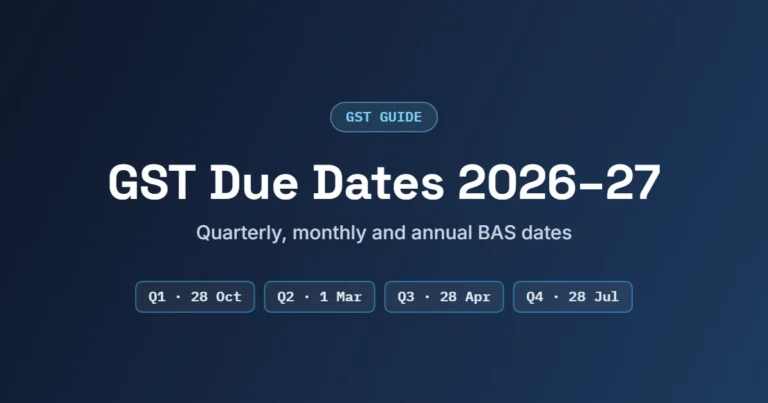
Quarterly BAS is due on 28 October, 28 February (1 March in 2027), 28 April and 28 July, with extra time if you lodge online or through a tax agent. Our GST due dates calendar has the exact 2026–27 dates, and our guide to lodging your BAS covers each label.
Income tax is separate. Your fares, minus the GST and your deductions, go on your individual tax return, so set money aside for that as well.
Fuel tax credits don’t apply
Plenty of drivers assume they can claim fuel tax credits too. You can’t for a car. The ATO says fuel used in light vehicles on public roads for ride-sourcing isn’t eligible. You still claim the GST on fuel through your BAS, just not the separate fuel tax credit.
Mistakes that cost rideshare drivers money
- Starting to drive before registering for GST
- Reporting the net payout instead of gross fares at G1 and 1A
- Forgetting to claim the GST on the platform’s service fee
- Claiming 100% of car costs without a logbook to back it up
- Claiming GST on rego, which has none
- Assuming food delivery follows the same rules as rideshare
For the errors that trip up every kind of business, see common BAS mistakes.
Frequently asked questions
Do I need to register for GST if I only drive part time?
Yes. The rule applies from your first paid trip, however little you drive. There’s no minimum income for rideshare drivers.
Do Uber Eats drivers need to register for GST?
Not automatically. Food delivery isn’t taxi travel, so you only need to register once your turnover reaches $75,000. If you’re already registered because you also drive passengers, GST applies to your delivery income too.
How do I calculate GST on Uber fares?
Divide your gross fares by 11. If riders paid $3,300 this month, the GST is $300. Use the gross fare figure from your tax summary, not the amount paid into your bank.
Can rideshare drivers claim GST on fuel?
Yes, for the business share. If your logbook shows 75% business use and you spent $1,100 on fuel, you claim $100 × 75% = $75. You can’t claim fuel tax credits on top.
Can I lodge my GST annually as an Uber driver?
No. Rideshare drivers must report GST quarterly or monthly. Annual GST reporting isn’t an option.
What if I’ve been driving without registering for GST?
Register now and backdate your registration to when you started. You’ll owe GST on past fares but can also claim credits for that period. Talk to a registered tax agent if it’s been more than a quarter or two, because penalties can apply.