
Why You Divide by 11 for GST (Not by 10)
You divide by 11 because a GST-inclusive price is made up of 11 equal parts — 10 parts base price and 1 part GST. The GST isn’t 10% of the total. It’s 10% of the original price before GST was added. That’s a different number, and mixing them up is the single most common GST calculation mistake in Australia.
Here’s the quick version: take any GST-inclusive amount, divide it by 11, and you get the GST component. Divide $220 by 11 and you get $20 GST. Divide $550 by 11 and you get $50 GST. It works every time because Australia’s GST rate is a flat 10%, and 10% added to a base creates a total that’s always 11 parts.
Our complete guide to calculating GST covers all three formulas — adding, removing, and finding the GST component. This post goes deeper on the divide-by-11 rule specifically: why the maths works, what goes wrong when you divide by 10 instead, and how to use it to spot-check receipts, invoices, and BAS figures in seconds.
THE RULE IN ONE LINE
To find the GST inside any GST-inclusive price in Australia, divide the total by 11. The result is the GST amount. The rest is the base price. Works for any amount, every time.
The 11 Parts Explained
Think of a GST-inclusive price as a chocolate bar broken into 11 equal pieces. Ten pieces are the base price. One piece is the GST. When you divide by 11, you’re pulling out that one piece.
Say a tradie quotes you $100 for a job, ex GST. Adding 10% GST means multiplying by 1.1 — so the final price is $110. That $110 is now made up of $100 (the quote) plus $10 (the GST). Eleven parts of $10 each. The GST is one-eleventh of the total, not one-tenth.
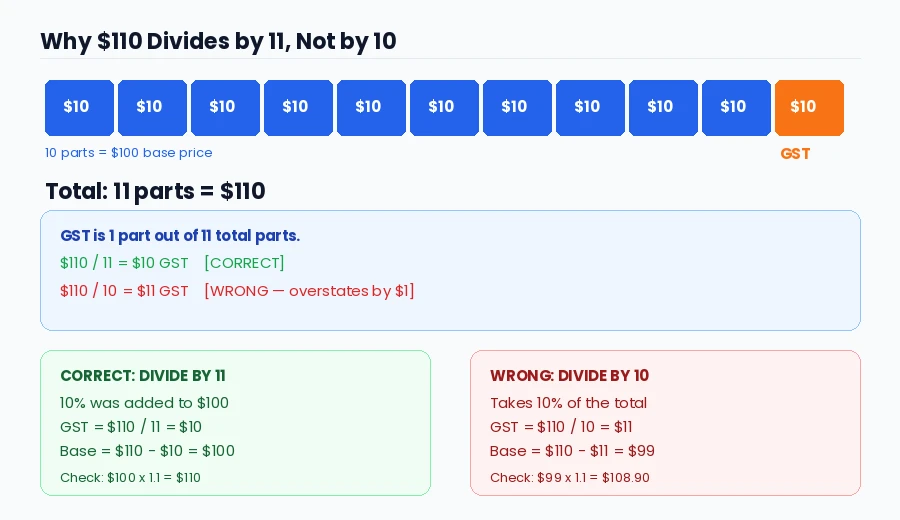
That’s the whole thing. GST is always one-eleventh of the inclusive total. Not one-tenth. The confusion happens because people hear “10% tax” and assume they should take 10% of whatever number they’re looking at. But 10% was calculated on the original price — not the price you’re looking at now, which already has the tax baked in.
What Goes Wrong When You Divide by 10
Dividing by 10 instead of 11 doesn’t just give you a slightly different number. It overstates the GST on every single transaction. And those errors compound across a quarter.
✅ Correct: ÷ 11
$110 ÷ 11 = $10 GST
$550 ÷ 11 = $50 GST
$1,100 ÷ 11 = $100 GST
$33,000 ÷ 11 = $3,000 GST
❌ Wrong: ÷ 10
$110 ÷ 10 = $11 (+$1 error)
$550 ÷ 10 = $55 (+$5 error)
$1,100 ÷ 10 = $110 (+$10 error)
$33,000 ÷ 10 = $3,300 (+$300 error)
On a single $110 receipt, the error is $1. Doesn’t sound like much. But a sole trader processing $200,000 in GST-inclusive sales across a year would calculate $20,000 GST using ÷10 instead of the correct $18,181.82 using ÷11. That’s an $1,818 discrepancy on the BAS — enough to trigger an ATO review.
How to Spot-Check Any Receipt
This is where the ÷11 rule earns its keep in daily life. Every tax invoice and receipt from a GST-registered business in Australia shows a total. Grab that total, divide by 11 on your phone, and you’ve got the GST component. Takes three seconds.
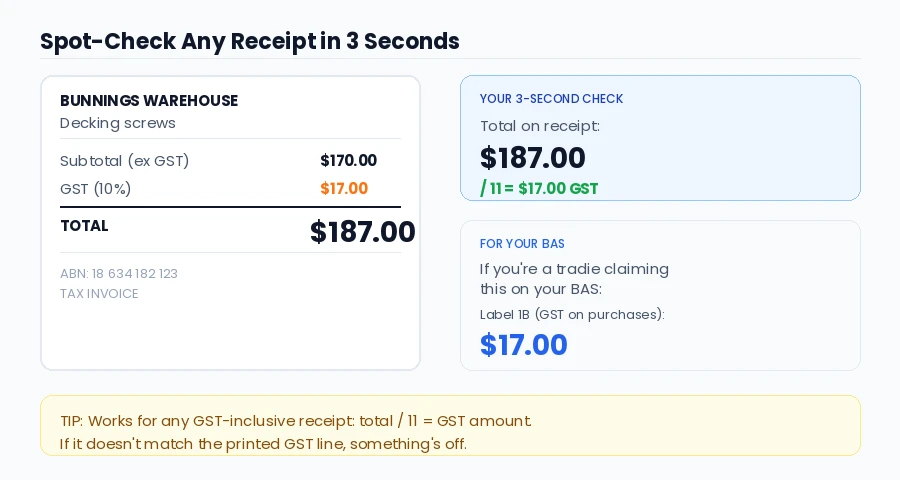
Picked up $187 worth of decking screws from Bunnings? $187 ÷ 11 = $17 GST. If the printed GST line on the receipt says $17.00, it’s correct. If it says something else, either the receipt has a mix of GST-free and taxable items, or there’s an error worth looking into.
For businesses, this becomes a habit. Every invoice that lands in your inbox, every supplier bill, every expense — a quick ÷11 tells you exactly how much GST credit you’re about to claim on your BAS return.
The BAS Connection
The divide-by-11 rule sits at the heart of your Business Activity Statement. When you lodge BAS each quarter, two labels matter most for GST:
📤
Label 1A — GST on sales
Total GST you collected from customers. For most small businesses: your taxable sales ÷ 11.
📥
Label 1B — GST on purchases
Total GST you paid on business expenses. Add up your expense receipts ÷ 11 to get this figure.
Net GST payable = 1A minus 1B. If you collected more GST than you paid, you owe the difference to the ATO. If you paid more than you collected, the ATO refunds you. Either way, the ÷11 formula is how both numbers get calculated.
WORKED EXAMPLE — QUARTERLY BAS
A builder invoiced $44,000 in taxable sales this quarter (GST-inclusive).
Label 1A: $44,000 ÷ 11 = $4,000 GST collected.
Business expenses totalled $16,500 (GST-inclusive) from registered suppliers.
Label 1B: $16,500 ÷ 11 = $1,500 GST paid.
Net GST payable: $4,000 − $1,500 = $2,500 to the ATO.
When the ÷11 Rule Doesn’t Apply
The rule works perfectly when the entire amount is taxable at 10%. But there are a few situations where you can’t just divide the total by 11 and get the right answer.
Mixed receipts
A grocery receipt from Woolworths includes both GST-free items (fresh fruit, bread, milk) and taxable items (chips, chocolate, cleaning products). You can’t divide the whole receipt by 11 — only the taxable portion attracts GST. Use the printed GST line on the receipt instead. For more on what’s taxed and what’s not, see our guide to GST on food.
Margin scheme transactions
Property sales under the GST margin scheme calculate GST as one-eleventh of the margin (sale price minus purchase price), not one-eleventh of the total sale price. Our margin scheme calculator handles this automatically.
Non-standard GST rates (outside Australia)
The ÷11 shortcut only works because Australia’s GST is exactly 10%. Countries with different VAT/GST rates use different divisors. New Zealand’s 15% GST uses ÷23×3. The UK’s 20% VAT uses ÷6. This post covers Australian GST only.
Quick Mental Maths Tricks
Dividing by 11 in your head is easier than it sounds if you know a couple of shortcuts.
Three shortcuts for dividing by 11
Round numbers: $110 → move the decimal, drop a zero → $10. Works for any multiple of $11.
The 10% then adjust method: take 10% of the total ($187 → $18.70), then subtract about 10% of that ($1.87). Result: roughly $16.83. Actual answer: $17.00. Close enough for a mental check.
The phone calculator shortcut: just type the total, hit ÷, type 11, hit =. Faster than any other method. Use our GST calculator if you want the breakdown done for you.
The Excel Formula
If you work with GST figures in spreadsheets, there’s one formula worth memorising.
=ROUND(A1/11, 2)
Put the GST-inclusive amount in cell A1. This formula returns the GST component rounded to the nearest cent. The ROUND function prevents fractional-cent issues that mess up BAS reconciliation.
If you want the base price instead: =ROUND(A1/1.1, 2). And to add GST to an ex-GST price: =ROUND(A1*1.1, 2).
Frequently Asked Questions
Why don’t you just take 10% of the total to find GST?
Because 10% was added to the original price, not to the total. A $100 item plus 10% GST equals $110. The GST is $10, which is one-eleventh of $110 — not one-tenth. Taking 10% of $110 gives you $11, which is wrong. That $1 error per $110 adds up fast across a full BAS quarter.
Does ÷11 work for all GST calculations in Australia?
It works whenever the full amount is taxable at 10% GST. It doesn’t work for mixed receipts (with both taxable and GST-free items), margin scheme property transactions, or purchases from unregistered suppliers. For those, use the printed GST line or a specific calculator.
How do I find the price before GST was added?
Divide the GST-inclusive price by 1.1. That gives you the base price. For example, $550 ÷ 1.1 = $500 base price. The GST component is $550 ÷ 11 = $50. Two different divisions — ÷1.1 for the base, ÷11 for the GST.
What’s the GST on $1,000 inclusive?
$1,000 ÷ 11 = $90.91 GST. The base price is $1,000 ÷ 1.1 = $909.09. Check: $909.09 + $90.91 = $1,000.00.
This is exactly how you’d work out the GST on a car purchase. Our guide to GST on cars walks through examples at $30,000, $50,000 and $80,000.
Can I use ÷11 to check my BAS figures?
Yes. Your BAS label 1A (GST on sales) should roughly equal your total taxable sales divided by 11. Label 1B (GST on purchases) should roughly equal your total business expenses divided by 11. If either figure is noticeably different, dig into the individual invoices to find the discrepancy before you lodge.
Is dividing by 11 an ATO-approved method?
Yes. ASIC’s MoneySmart GST calculator page states: “divide a GST inclusive cost by 11 to work out the GST component.” The ATO’s own calculation worksheets use the same formula. It’s the standard method for extracting GST from any inclusive price in Australia.
What if my receipt shows a different GST amount than ÷11 gives me?
Usually means the receipt includes a mix of taxable and GST-free items. A supermarket receipt with bread, milk, and cleaning products won’t divide cleanly by 11 because the bread and milk are GST-free. Only the taxable items have GST. Use the printed GST total on the receipt instead.
Does this rule apply to New Zealand GST?
No. New Zealand’s GST rate is 15%, so their divisor is different (÷23×3 or ÷7.667). The ÷11 shortcut only works because Australia’s GST is exactly 10%. Each country’s rate produces its own divisor.


4 Comments
Comments are closed.