
ATO rules · Updated 22 Nov 2026
Does Electricity Have GST? Check Any Bill or Fee
Yes. Electricity includes 10% GST on the usage and supply charges. Bank fees, interest, council rates, land tax, stamp duty, ASIC fees and fines don’t. Search any bill to see if GST is in the price and whether your business can claim it.
- 38 common bills, fees and taxes in one search
- Shows whether a business can claim the GST
- Checked against current ATO guidance
Covers 38 common bills, fees and taxes. Based on ATO guidance, reviewed 22 November 2026.
Power bills
Does Electricity Have GST?
Yes. Electricity in Australia includes 10% GST. It applies to the usage rate (cents per kWh) and the daily supply charge, and retailers quote both with GST already included.
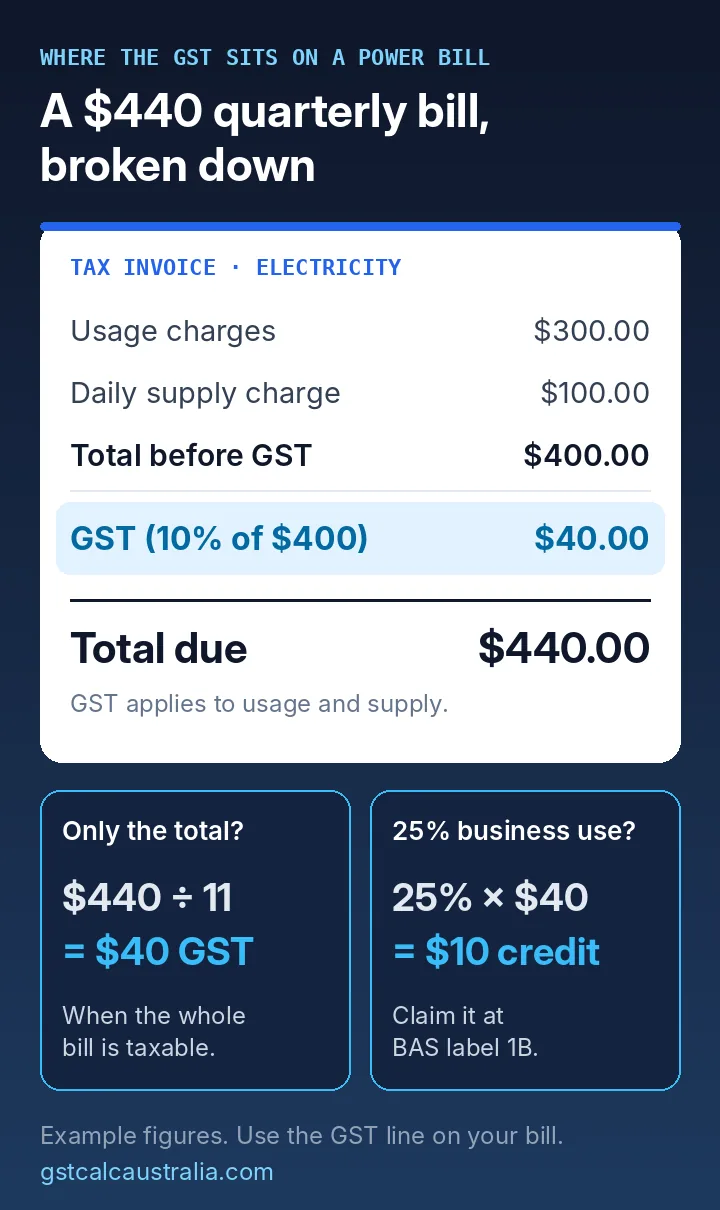
Your power bill is also a tax invoice. It shows the GST for the billing period on its own line, so there’s nothing to work out. If you only have the total, divide it by 11: a $440 quarterly bill holds $40 of GST. Here’s why dividing by 11 works.
Gas bills follow the same rule: GST sits in the usage and supply charges.
Can a business claim the GST on electricity?
Yes, if you’re registered for GST and the power is used in your business. You claim the GST shown on the bill at label 1B of your BAS. If you also use the power privately, claim only the business share. The ATO’s rule is simple: 50% business use means 50% of the GST.
Working from home is where people get stuck. If 25% of that $440 bill is for business, the credit is $10. The ATO works out the business share of home power by floor area and hours of use, and the same share applies to the GST.
Do energy bill rebates have GST?
No. The federal Energy Bill Relief Fund credits weren’t subject to GST, and retailers applied them after the GST-inclusive total, so they didn’t reduce the GST on the bill. That fund ended on 31 December 2025, so 2026 bills don’t carry it. State concessions are separate and still run in most states.
Is there GST on solar feed-in credits?
Not for a household that isn’t running a business. It changes when the solar system is used in a GST-registered business: the power you export becomes a taxable sale, and retailers such as Tango Energy add GST to the feed-in payment once you tell them you’re registered.
Bank fees
Do Bank Fees Have GST?
No. Account-keeping fees, ATM fees, overdraft fees and loan interest are financial supplies. They’re input taxed, so there’s no GST in the price and no GST credit to claim.
The ATO lists bank fees and loan interest among the purchases you can’t claim GST on. A $100 bank fee doesn’t contain $9.09 of GST, so nothing goes to 1B.
Are bank fees GST-free or BAS excluded?
This is the question that fills accounting forums, and the honest answer is that the BAS result is the same either way: no GST and no credit. The ATO’s own Simpler BAS bookkeeping guide lists bank fees and interest as “not reported on the BAS for GST”, which is what the BAS Excluded code does in Xero and MYOB.
What you must not do is code them as GST on expenses. Our GST codes guide explains each code.
International transaction fees charged by your bank are generally input taxed too. Check the statement: if a fee is taxable, the bank shows the GST.
Card payments
Do Merchant Fees Have GST?
Usually, yes. Merchant fees pay for a card-payment service, not for credit, so they include 10% GST that a registered business can claim.
The ATO describes merchant services as a taxable supply, unlike the input-taxed bank fees above. A $605 monthly merchant fee includes $55 of GST. Your provider’s monthly statement or tax invoice shows the exact amount.
- Stripe: GST applies to all Stripe fees for Australian accounts, and Stripe sends a monthly tax invoice.
- Square: Square puts a monthly tax invoice in your dashboard showing the GST on processing fees.
- Bank EFTPOS terminals: the merchant service fee and terminal rental are on your monthly merchant statement, with GST shown.
What about card surcharges?
Businesses can no longer add them. The Reserve Bank ended card surcharging on eftpos, Mastercard and Visa payments from 1 October 2026. Before that, a surcharge took the same GST treatment as whatever the customer was paying for.
Rates and land tax
Do Council Rates Have GST?
No. Council rates are a tax, and taxes aren’t subject to GST under Division 81 of the GST Act. Your rates notice has no GST on it and there’s nothing to claim.
The ATO names local government rates, stamp duty and payroll tax as examples of taxes, and no regulation makes any of them subject to GST. One exception sits on some notices: a commercial rubbish collection charge can include GST, according to the Simpler BAS guide.
Water and sewerage charges have no GST either, because the GST Act makes water supply GST-free.
Is there GST on land tax?
No. Land tax is a state tax, so the same rule applies. You won’t see GST on a land tax assessment.
When rates or land tax pick up GST
Two situations confuse people. First, a GST-registered commercial landlord who recovers rates or land tax from a tenant as outgoings usually adds GST, because the payment forms part of the rent for a taxable lease. Second, when you buy commercial property, the rates adjustment at settlement becomes part of the price, so GST can apply to it. In both cases the original rates bill still had no GST.
Duty
Does Stamp Duty Have GST?
No. Stamp duty (also called transfer duty) is a state tax, so no GST is added to it and you can’t claim a GST credit for it.
The catch is the other way round: duty is often worked out on a price that already includes GST. Queensland’s revenue office, for example, counts GST added on top of a property price as part of the amount duty is charged on.
Stamp duty on a car works the same way. The GST on cars guide covers rego, duty and the luxury car tax.
Is stamp duty GST-free or BAS excluded?
BAS excluded. The ATO’s bookkeeping guide lists stamp duty, fines, donations and most government taxes as not reported on the BAS for GST. “GST-free” is a different label: it covers sales with no GST where the seller can still claim credits, like basic food.
Insurance
Is There GST on Insurance?
It depends on the type. Most general insurance includes GST. Life insurance is input taxed and private health insurance is GST-free.
| Insurance | GST in the premium? | Can a business claim it? |
|---|---|---|
| Car, home, contents, business, public liability | Yes | Yes, the business share |
| Workers compensation (WorkCover) | Yes | Yes |
| CTP (green slip) | Yes | Yes, the business share |
| Life insurance | No, input taxed | No |
| Income protection | No, when issued by a life insurer | No |
| Private health insurance | No, GST-free | No |
Stamp duty on an insurance premium has no GST, so claim the GST line only, not the duty.
Is there GST on an insurance payout?
Not if you tell your insurer, before you claim, what percentage of the premium’s GST you’re entitled to claim. If you don’t, the ATO says you may have to pay GST when the claim is settled.
Government charges
Government Fees, Fines and Charges
Most have no GST. ASIC fees and fines don’t include GST. Parking meters and road tolls are the exceptions: they can include GST even when a government body charges them.
- ASIC fees: company registration, annual review and business name fees aren’t subject to GST.
- Fines and penalties: parking fines, speeding fines and ATO penalties have no GST, because a fine isn’t payment for anything.
- Parking and tolls: the GST regulations don’t exempt metered or ticketed parking, or road tolls, so GST applies when the operator is registered.
- Car rego: the registration fee has no GST, but the CTP insurance bundled into it does. Claim only the GST on that part. Details are in the GST on cars guide.
At a glance
Other Common Costs and GST
The everyday costs below come up in most businesses. GST-free and input taxed both mean there’s no GST in the price; the difference matters to the seller, not to you.
| Cost | GST in the price? | Can a business claim it? |
|---|---|---|
| Phone and internet | Yes | Yes, the business share |
| Water and sewerage | No, GST-free | No |
| Commercial rent | Yes, if the landlord is registered | Yes |
| Residential rent | No, input taxed | No |
| Strata levies | Only if the owners corporation is registered | Only if GST is shown |
| Domestic flights | Yes | Yes, if for business |
| International flights | No, GST-free | No |
| PEXA settlement fees | Yes | Yes |
| Face-value gift cards | Not when bought; GST applies when spent | When redeemed |
| Donations to charity | No | No |
| Wages and super | No | No |
An owners corporation must register for GST once its turnover, levies included, reaches $75,000, or $150,000 if it’s a non-profit body. Overseas software and streaming services are covered in our overseas subscriptions guide.
Quick check
How to Tell If a Bill Includes GST
- Look for the words “tax invoice” and the supplier’s ABN at the top.
- Find a GST line, or a statement that the total price includes GST.
- No GST line? Divide the total by 11 only if the supplier is registered for GST. Our GST calculator does it instantly.
- If there’s no ABN and no GST shown, assume there’s no GST to claim.
- For purchases over $82.50 including GST, you need a valid tax invoice before you claim.
Every GST credit you claim follows the rules in our guide to claiming GST credits, including the four-year time limit.
FAQs
Bills, Fees and GST: FAQs
Written and reviewed by the GST Calculator Australia team against current ATO guidance. Last reviewed 22 November 2026. General information only, not tax advice: check your own tax invoices, and speak to a registered tax or BAS agent if your situation is unusual. See our editorial policy.