7 Common BAS Mistakes and How to Avoid Them
The seven BAS mistakes below are the ones the ATO flags most often, and they’re all avoidable. Late lodgement, wrong GST codes, missing invoices, personal expenses claimed as business, mixing up cash and accrual reporting, forgetting to lodge a nil BAS, and skipping the reconciliation step before hitting submit.
Each one can trigger penalties, interest charges or an ATO review. And with the penalty unit sitting at $364 from 1 July 2026, even a single late BAS can cost you up to $1,820 before interest starts compounding on top.
Here’s what goes wrong, why it happens, and how to stop it.
Quick answer
Most BAS mistakes come down to rushing at the deadline. The fix isn’t complicated: reconcile your accounts before you lodge, keep tax invoices for anything over $82.50, separate personal and business spending, and lodge on time even if the amount is zero. That covers about 90% of what the ATO catches.
Mistake 1: Lodging Your BAS Late (or Not at All)
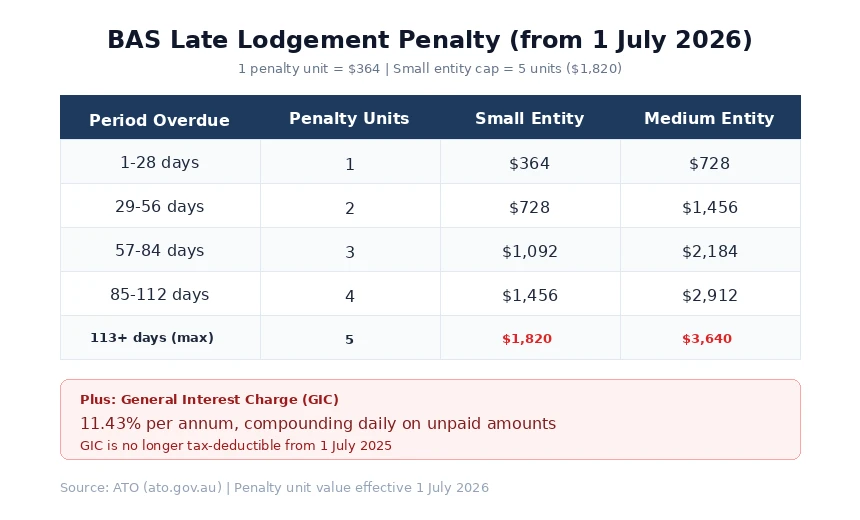
This is the most common one, and it’s the easiest to avoid. The ATO applies a Failure to Lodge (FTL) penalty for every 28-day period your BAS is overdue, up to a maximum of five penalty units.
From 1 July 2026, one penalty unit is $364. So a BAS that’s five months late can cost a small business up to $1,820 in FTL penalties alone. Medium entities (turnover $1 million to $20 million) pay double that.
On top of the FTL penalty, the ATO charges a General Interest Charge (GIC) on any unpaid tax. The current GIC rate for Q1 2026-27 is 11.43% per annum, compounding daily. And since 1 July 2025, GIC is no longer tax-deductible.
The fix: Set a calendar reminder two weeks before each quarterly deadline. Lodge on time even if you can’t pay yet. The penalty for not lodging is separate from the debt itself, and it stacks. If you genuinely can’t meet the deadline, contact the ATO or your BAS agent before the due date to request an extension.
Mistake 2: Getting the GST Codes Wrong
Incorrect GST coding is the number one trigger for ATO reviews in 2026. It happens when transactions get tagged with the wrong tax code in your accounting software. The most frequent version: claiming GST credits on expenses that are GST-free or input-taxed.
Bank fees, government charges, ASIC registration fees, insurance premiums on certain policies, residential rent, and interest on loans. None of these include GST. But they regularly show up on BAS returns with GST credits claimed.
The reverse also happens. A business pays for something that does include GST but codes it as GST-free, missing a legitimate credit.
The fix: Before lodging, run a GST exceptions report in your accounting software. Look for transactions coded as GST that shouldn’t be (bank fees, government charges, insurance), and transactions coded as GST-free that should carry GST. If you’re not sure whether something includes GST, check the supplier’s invoice. Our guide on GST-free items in Australia covers the main categories.
Mistake 3: Claiming GST Credits Without a Valid Tax Invoice
You need a valid tax invoice for every GST credit you claim on purchases over $82.50 (including GST). That’s the ATO’s rule, not a suggestion. A bank statement or a PayPal receipt doesn’t count.
The $82.50 figure is simply $75 plus 10% GST. Below that threshold, alternative evidence like an EFTPOS receipt or a till docket is acceptable. Above it, you need a proper tax invoice with all seven required fields.
And if a supplier hasn’t given you one? You can request it. They have 28 days to provide it. But you need to wait until you actually have the invoice before claiming the credit on your BAS, even if that means claiming it in a later period.
The fix: Capture every invoice at the point of purchase. Use your accounting app’s document scanner or a dedicated receipt app. Before lodging, check that every GST credit over $82.50 has a matching invoice on file. For a full breakdown of what the ATO requires on each invoice, see our guide to GST tax invoice requirements.
Mistake 4: Claiming Personal Expenses as Business
Personal groceries claimed through the business account. A family holiday coded as a business trip. A home internet bill claimed at 100% when the business use is closer to 40%. The ATO sees all of these regularly, and its matching software catches them faster than you’d expect.
This one’s about honesty and record-keeping. If something is genuinely split between business and personal use, you can claim the business portion. But you need to calculate and document that split, not just guess.
The fix: Keep business and personal spending in separate bank accounts. For mixed-use expenses (phone, internet, vehicle), calculate the business percentage and document how you worked it out. Claim only the business portion. Our input tax credit guide explains the apportionment rules.
Mistake 5: Using the Wrong Accounting Method
Cash accounting reports GST when money changes hands. Accrual accounting reports GST when invoices are issued, regardless of payment. Mixing them up on your BAS throws every number off.
The typical scenario: a business is set up for cash accounting in its software but manually enters figures on the BAS as if it’s reporting on an accrual basis. Or the reverse. Either way, the GST collected and GST paid figures don’t match reality, and the net amount is wrong.
Cash accounting is available to businesses with turnover under $10 million. It’s simpler for most small operators because you only report GST on sales you’ve actually been paid for, which is kinder to cash flow.
The fix: Check which method you selected when you registered for GST. Confirm your accounting software matches. If you’re unsure, log into the ATO’s Online Services for Business and check your GST account details. Don’t change methods mid-quarter without talking to your accountant first.
Mistake 6: Forgetting to Lodge a Nil BAS
No sales this quarter? No expenses? You still need to lodge. A nil BAS reports zeros across the board, but the ATO expects to receive it on time regardless. Skip it and you’ll cop the same FTL penalty as any other late BAS.
This trips up seasonal businesses, new businesses still setting up, and anyone who takes a quarter off. The obligation is triggered by your GST registration, not by whether you traded.
The fix: If you’re registered for GST, lodge every quarter. Period. A nil BAS takes two minutes through myGov or ATO Online Services. If you’ve permanently stopped trading, cancel your GST registration instead of letting nil returns pile up.
Mistake 7: Not Reconciling Before You Lodge
Plenty of small business owners pull the figures from their accounting software and lodge without checking them against bank statements, invoices and payment records. That’s how duplicate transactions, missing entries and incorrect GST codes slip through.
Reconciliation is the step that catches the other six mistakes on this list. It’s also the step most people skip because BAS is due tomorrow and they haven’t started.
The fix: Reconcile your bank feeds at least weekly, not quarterly. By the time BAS is due, your books should already be clean. Run the BAS report in your software, compare it to your bank statement totals, and review any unreconciled transactions before you lodge.
What Happens When the ATO Catches a Mistake?
It depends on the size and nature of the error.
Minor errors (under $10,000 and not the result of reckless behaviour) can usually be corrected on your next BAS. You adjust the figures in the relevant labels and the ATO picks up the correction automatically.
Significant errors need a formal amendment. You lodge a revised BAS through ATO Online Services or through your BAS agent. The ATO may also apply a shortfall penalty if the mistake reduced your GST liability, with the amount depending on whether the error was careless (25% of the shortfall), reckless (50%), or intentional (75%).
And on top of penalties, GIC keeps ticking at 11.43% per annum on any underpaid amount until it’s cleared.
The ATO does offer penalty remission in genuine cases of hardship, first-time mistakes, or situations where you voluntarily disclosed the error. But the simplest path is getting it right the first time.
A Simple Pre-Lodgement Checklist
Run through this before every BAS submission:
Bank accounts reconciled to the last day of the quarter
GST codes reviewed: no credits claimed on GST-free or input-taxed items
Valid tax invoice on file for every GST credit over $82.50
Personal expenses separated from business claims
Accounting method matches your GST registration (cash or accrual)
BAS report totals compared against bank statement totals
Lodged on or before the due date, even if the result is nil
Frequently Asked Questions
What are the most common BAS mistakes in Australia?
Late lodgement, incorrect GST coding, claiming credits without valid tax invoices, mixing personal and business expenses, using the wrong accounting method, skipping nil returns, and not reconciling before lodging. The ATO flags all seven regularly, and each one can attract penalties, interest or a review.
How much is the penalty for a late BAS in Australia?
From 1 July 2026, the ATO charges one penalty unit ($364) for each 28-day period your BAS is overdue, up to five units. That’s a maximum of $1,820 for small entities. Medium entities pay double. The penalty applies even if no tax is owed, and GIC at 11.43% per annum compounds daily on any unpaid amount.
Can I fix a BAS mistake without getting penalised?
Minor errors (generally under $10,000 and not reckless) can be corrected on your next BAS by adjusting the relevant labels. Larger or more serious mistakes require a formal amendment through ATO Online Services. The ATO may still apply a shortfall penalty on significant under-reporting, but voluntary disclosure usually reduces the penalty amount.
Do I need to lodge a BAS if I had no sales?
Yes. If you’re registered for GST, you must lodge a BAS every reporting period regardless of whether you made any sales. A nil BAS reports zeros across all labels. Not lodging it triggers the same late-lodgement penalty as any other missed BAS.
Do I need a tax invoice to claim GST credits?
For purchases over $82.50 (including GST), yes. You need a valid tax invoice with the seven fields the ATO requires. For purchases of $82.50 or less, alternative evidence like an EFTPOS receipt is acceptable. A bank statement on its own is not enough for either threshold.
What is the difference between cash and accrual accounting for BAS?
Cash accounting reports GST when payment is received or made. Accrual accounting reports GST when invoices are issued, regardless of payment timing. Cash is available to businesses under $10 million turnover and is generally simpler for small operators. Whichever method you choose at registration should match what your accounting software uses.
How do I find out which GST accounting method I’m using?
Log into the ATO’s Online Services for Business and check your GST account details. It shows whether you’re registered for cash or accrual reporting. If your software is set up differently, that’s a problem worth fixing before your next BAS.
What is the GST component of a price that includes GST?
Divide the GST-inclusive price by 11. That gives you the GST amount. So $550 includes $50 of GST and a base price of $500. You can see why this formula works in our explanation of the divide-by-11 method, or use our GST calculator for an instant answer.
Disclaimer: This guide is general information only, current as at September 2026. It is not financial, tax or legal advice. GST rules can change, and individual circumstances vary. Consult a registered tax agent or BAS agent, or contact the ATO directly, for advice about your specific situation.