Input-Taxed Supplies in Australia: What They Are and What They Cost You
Quick answer
An input-taxed supply is a sale with no GST in the price, where the seller also can’t claim GST credits on the costs of making it. The two big ones are residential rent (and sales of existing homes) and financial supplies such as lending money. The GST you pay on related costs simply stays a cost.
That last part is what catches people out. Plenty of landlords and small business owners assume “no GST on the sale” means the same thing as GST-free. It doesn’t, and the difference shows up on every repair bill and agent invoice.
What does input-taxed mean?
“Input-taxed” describes where the tax ends up. GST isn’t charged on the sale (the output), but the GST you paid on your inputs, things like repairs, fees and equipment, can’t be claimed back. So the tax is effectively locked into your inputs.
The ATO’s wording is simple: if you make an input-taxed sale, you’re not entitled to credits for the GST in the price of your inputs. Compare that with a GST-free sale, where no GST is charged but you can still claim credits. If you want the bigger picture of all three sale types, our guide to what GST is in Australia covers taxable supplies too.
Not to be confused with: an input tax credit is the GST you claim back on business purchases. An input-taxed sale is the opposite situation: one where you can’t claim those credits. Similar words, opposite results. Our guide to input tax credits explains how claiming works.
What counts as an input-taxed supply?
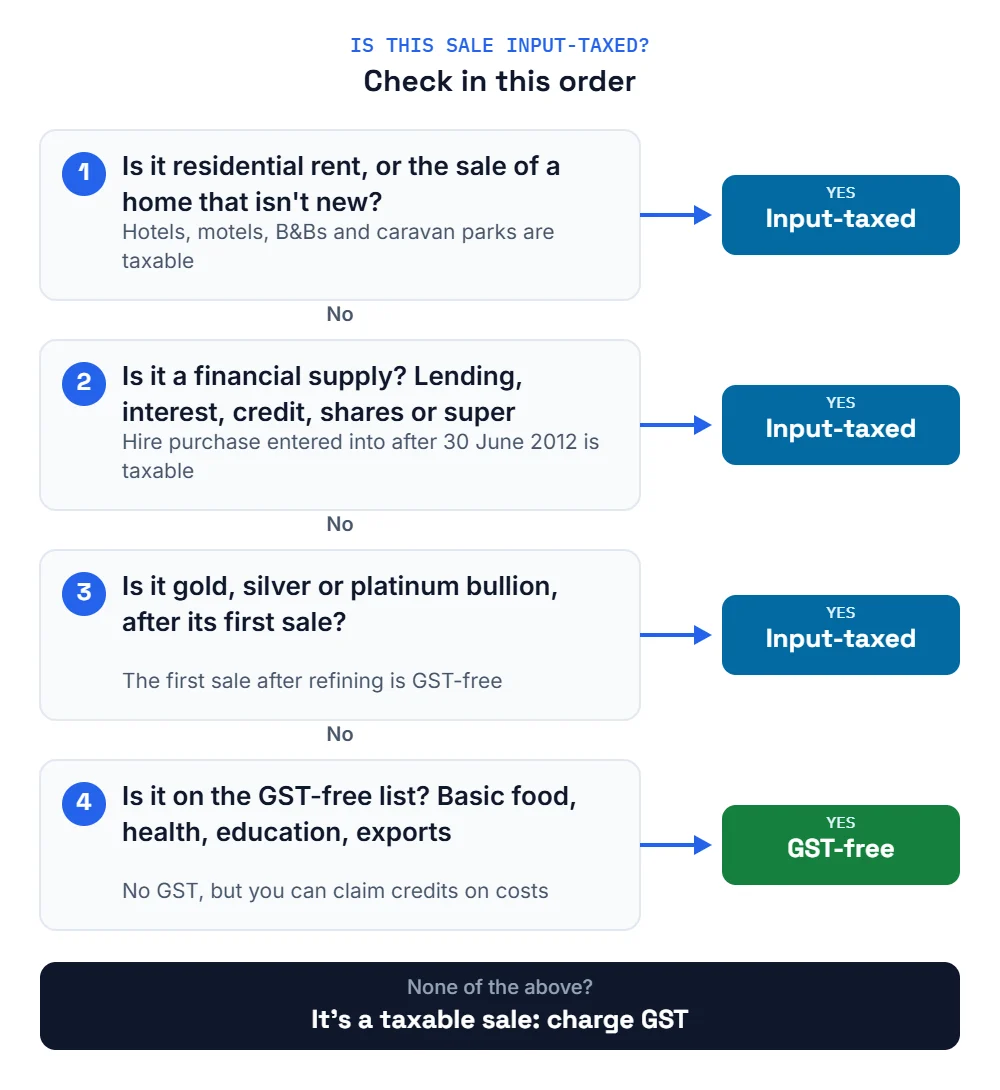
Only certain categories set out in the GST law are input-taxed. Everything else a GST-registered business sells is taxable unless it’s GST-free. Here’s the full practical list.
|
Category |
Examples |
Watch out for |
|---|---|---|
|
Residential rent |
Renting out a house, unit or room as a home |
Hotels, motels, B&Bs and caravan parks are commercial residential premises, so they’re taxable |
|
Sale of existing residential premises |
Selling a home or unit that isn’t new |
New homes are taxable. A home stops being new 5 years after it was built or substantially renovated |
|
Financial supplies |
Lending money, charging interest, granting credit, buying or selling shares, interests in a super fund |
Credit under a hire purchase agreement entered into after 30 June 2012 is taxable |
|
Precious metals |
Gold, silver or platinum bullion of investment fineness, after its first sale |
The first sale after refining is GST-free |
|
Elected by eligible organisations |
School tuckshops run by not-for-profits, eligible fundraising events, long-term accommodation in commercial residential premises |
These are choices, not automatic. Conditions apply |
Source: ATO guidance on input-taxed sales, residential premises and financial supplies.
What input-taxed status actually costs you
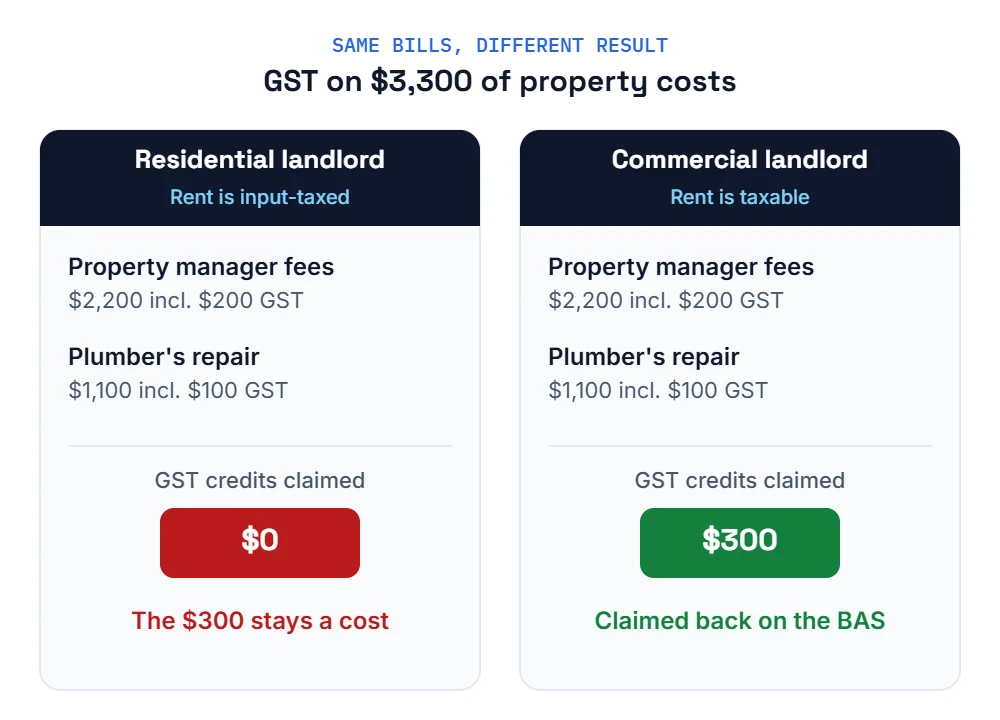
Here’s where the money goes. Say you own a rental unit and in one quarter you pay:
- Property manager fees of $2,200, including $200 GST
- A plumber’s bill of $1,100, including $100 GST
Because residential rent is input-taxed, you can’t claim that $300 of GST. It’s simply part of your costs. A shop owner with exactly the same two bills for a commercial property would claim the full $300 back on their BAS.
And it applies even if you’re GST-registered for another business. The ATO is clear that GST doesn’t apply to residential rent, and you can’t claim credits for associated expenses, even if you carry on another GST-registered enterprise.
Bank fees, interest and merchant fees: which is which?
This is the single most asked question on the ATO Community forum about input-taxed supplies, with one thread passing 48,000 views. The confusion comes from mixing up the bank’s sale with your purchase.
|
Transaction |
Treatment |
What you do |
|---|---|---|
|
Interest you earn on a business account |
Input-taxed sale (a financial supply) |
Include it in G1 Total sales. No GST |
|
Account fees and loan interest you pay |
No GST in the price, because the bank’s supply is input-taxed |
Nothing to claim. Not reported on Simpler BAS |
|
Merchant fees for card payment facilities |
Taxable, GST applies |
Claim the GST shown on the merchant’s tax invoice |
|
Interest under a hire purchase agreement entered into after 30 June 2012 |
Taxable |
GST applies to the credit component |
The ATO’s own forum team confirmed that bank fee purchases take a ‘No GST’ code and don’t need to be reported on the BAS. For what each code is called in Xero, MYOB and QuickBooks, see GST codes explained.
Landlords, Airbnb and serviced apartments
Whether rent is input-taxed depends on the type of premises, not on how short the stay is.
- A house, unit or spare room on Airbnb: generally treated as residential rent, so it’s input-taxed. No GST on the nightly rate, and no GST credits on cleaning, linen or repairs.
- Hotels, motels, B&Bs, hostels and caravan parks: these are commercial residential premises, so the accommodation is taxable.
- A strata apartment you lease to a serviced-apartment operator: the ATO says your individual apartment is still residential, so your lease to the operator is input-taxed, even though the operator’s supply to guests is taxable.
If you’re running something closer to a guesthouse with staff and services, the answer can change. The ATO has a guide to commercial residential property that lists the features it looks at.
Does input-taxed income count towards the $75,000 GST threshold?
No. Input-taxed sales are left out when you work out your GST turnover. So if residential rent is your only income, you don’t need to register for GST, no matter how much rent you collect. The ATO’s own forum answer says exactly that for rental-only owners.
GST-free sales work differently: they do count towards the threshold. A business selling only GST-free food can still need to register. For the full rules, see how to register for GST.
How do you report input-taxed sales on your BAS?
It depends on your reporting method.
- Simpler BAS (the default if your GST turnover is under $10 million): include input-taxed sales in G1 Total sales. There’s no GST on them at 1A, and you don’t claim GST at 1B for purchases used to make them.
- Full reporting method: report them at G1 and at G4 Input-taxed sales, and record purchases used to make them at G13 on the calculation worksheet.
If input-taxed supplies are your main business activity, the ATO lets you choose the full reporting method even when you’d otherwise use Simpler BAS. For more on lodging, see our BAS and GST returns guide.
Mixed businesses: claiming the part you’re entitled to
Lots of owners make both kinds of sales. When one purchase serves both, you claim the GST credit only for the share used for taxable or GST-free sales. The ATO expects a method that’s fair and reasonable, and floor space is one of the measures it lists.
Worked example
You own a two-storey building: a shop leased to a tenant downstairs (taxable, 60% of the floor area) and a flat rented as a home upstairs (input-taxed, 40%). A roof repair costs $11,000, including $1,000 GST.
Claimable GST = $1,000 × 60% = $600. The other $400 relates to the flat and can’t be claimed.
There’s one useful exception for businesses that only dabble in financial supplies. If the GST credits on purchases for making financial supplies stay under the financial acquisitions threshold (no more than $150,000, and no more than 10% of your total GST credits), you can generally still claim them in full.
Changed your plans? Watch for GST adjustments
Input-taxed status is decided by what a purchase is actually used for, not only by what you planned. That matters most for property.
- Built to sell, then rented out: the ATO treats this as a change in creditable purpose, so you may need to pay back some GST credits you claimed on construction. If you later sell the home as new, you may get a decreasing adjustment.
- Rented for five years: a home rented out continuously for five years is generally no longer new, so its sale becomes input-taxed. Credits claimed on construction may need to be reversed.
- Small purchases: you generally don’t need an adjustment if the purchase cost $1,000 or less (GST-exclusive).
Getting this wrong with property can mean a large GST bill plus penalties, so speak to a registered tax agent before you change how a property is used.
Input-taxed supplies: frequently asked questions
Is input-taxed the same as GST-free?
No. Neither has GST in the price, but GST-free sales still let you claim GST credits on related purchases. Input-taxed sales don’t. GST-free sales also count towards the $75,000 registration threshold, while input-taxed sales don’t.
Is input-taxed the same as an input tax credit?
No, they’re close to opposites. An input tax credit is GST you claim back on business purchases. An input-taxed sale is one where you can’t claim those credits for the costs of making it.
Is residential rent input-taxed?
Yes. Rent from a house, unit or room let as a home is input-taxed, so you don’t charge GST on it and can’t claim GST on agent fees, repairs or other costs of renting it out. Rent from commercial property and accommodation in hotels or motels is taxable.
Are bank fees input-taxed?
Most bank account fees and loan interest have no GST in the price because the bank’s supply is input-taxed, so there’s no credit to claim. Merchant fees for card payment facilities are different: they include GST, which you can claim.
Do I charge GST on Airbnb income?
Generally no. Renting out a home or a room in your home on Airbnb is treated as residential rent, which is input-taxed. The answer changes if the property is commercial residential premises, such as a hotel, motel or B&B.
Is stamp duty GST-free or input-taxed?
Neither. Stamp duty is a state tax, not a sale of goods or services, so GST doesn’t apply to it at all and it isn’t reported on your BAS.
This guide is general information based on ATO guidance, reviewed on 27 November 2026. It isn’t tax advice. GST on property and financial supplies depends on your circumstances, so check with the ATO or a registered tax agent before making decisions.